Guide to expensing roofing costs
Roofing costs can be significant expenses for businesses. Tax practitioners should know how to distinguish between deductible repairs and more extensive work that must be capitalized.
Each year, tax professionals who deal with real estate must evaluate the most recent building expenditures and determine which items should be written off as a repair expense or capitalized. The most common, and often significant, item that is evaluated is roofing-related work. In many cases, only a portion of the roofing system is replaced, and depending on the facts, those costs may be deducted as repairs. When compared to the alternative option of depreciating the cost over a 27.5-year life for residential rental real estate or a 39-year life for commercial real estate under the modified accelerated cost recovery system, an incorrect conclusion may lead to a significant overpayment of tax liability.
Observation: For the tax professional who has only cryptic invoice descriptions and no direct knowledge of the roof work, assembling the facts and circumstances can be a challenge. The key to properly evaluating the character and nature of the work performed is having a basic understanding of roofing systems and asking insightful questions.
This guide to expensing roofing costs provides tax preparers an outline of questions to ask clients and includes tables to reference when evaluating roof repair costs.
Analysis
A capital improvement is defined as an amount paid after a property is placed in service that results in a betterment, adaptation, or restoration to the unit of property or building system (Regs. Sec. 1.263(a)-3(d)). Replacing a substantial portion of any major component of a building meets the criteria of a capital improvement. A roof system is a major component because it performs a discrete and critical function in a building structure.
A roof system includes a roof structure and multiple layers of materials above it. The roof structure usually includes some type of deck spanning a network of load-bearing structural joists and beams. These load-bearing roof elements are less likely to be replaced unless a catastrophic failure occurs such as from a tornado or fire or long-term neglect of the roof cover. Our analysis focuses on the components above the load-bearing structural elements.
Step 1. What type of roof is it?
When evaluating this issue, it is important to have a basic knowledge of the physical characteristics of common roof systems. Roof systems are generally divided into two generic classifications: steep pitch and low pitch.
Steep-pitch roofing
Steep-pitch roof assemblies (typically used for residential rental properties) usually consist of three primary parts:
- Roof deck—the first layer above beams, usually a wood-based material similar to plywood and sometimes referred to as “sheathing.”
- Underlayment—provides a secondary weatherproofing barrier. Sometimes underlayment is referred to as “felt” or “paper.”
- Roof covering—can include various types of shingles, clay tile or concrete tile, slate, wood shakes, or metal roof systems for steep-pitch applications.
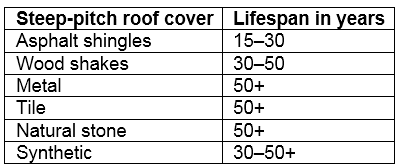
Generally, the average lifespan of steep pitch roofing covers is:
Low-pitch or flat roofing
Most low-pitch roofing (typically used for commercial buildings) consists of three sections:
- Roof deck—typically a corrugated metal panel supported by structural beams.
- Insulation—one distinction from steep-pitch roofing is that insulation is typically above the decking and may be replaced with the membrane layer.
- Roof cover or membrane—most low-pitch membranes or assemblies can be classified as built-up roof membranes, metal panel roof systems, modified bitumen sheet membranes, synthetic rubber membranes (e.g., EPDM), thermoplastic membranes (e.g., PVC, TPO), or spray polyurethane foam-based (SPF) roof systems.
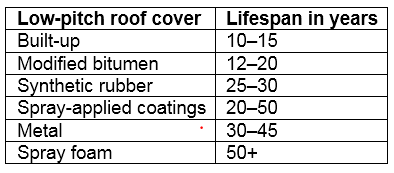
Generally, the average lifespan of low-pitch roofing covers is:
Step 2. Apply the regulations
Assess the betterment standard
Questions to assess whether the roof work is a capitalized betterment under Regs. Sec. 1.263(a)-3(j) include:
- Why was the roof replaced?
Generally, if it was due to sudden damage, the cost to bring the roof back to the same condition using the same materials is not a betterment.
- How much time elapsed between the building acquisition and the roof work?
- Generally, if roof work needs to be done soon after the building was acquired (e.g., two years later) it might fall into the betterment category because the work corrected a material defect or condition that existed before the building was acquired.
- However, if a long period of time has passed since the original building acquisition (e.g., seven years later) it generally does not fall into this category.
- What kind of roofing was there before and what kind was it replaced with?
- If improved materials were used, what was the expected life of the old roof and what is the expected life of the new roof? (See the tables above.)
Going from asphalt shingles (20-year life) to clay tile (50-year life) is a betterment because that would materially increase the capacity, efficiency, or quality of the building structure.
- Were improved roof materials used because comparable materials were no longer available or technology has advanced?
- If it’s not practical to use the old type of roofing system, it’s generally not a betterment.
- If the old roof materials performed worse than industry standard roofing material for that location and building type, it’s generally not a betterment under this test.
- If improved materials were used, what was the expected life of the old roof and what is the expected life of the new roof? (See the tables above.)
- Did the roof work relate to a physical enlargement of the building?
If so, the enlargement portion of the roof is capitalized and, depending on the facts, possibly the entire roof system.
Restorations
Questions to assess whether the roof work is a capitalized restoration include:
- Why did the roof need to be replaced?
- How much of each roof layer was replaced?
- If only the outer roof covering (membrane, shingles, etc.) was replaced but none of the underlying roof system, it is not a restoration.
- If any load-bearing structural elements (including decking and sheathing) were replaced that supported more than 40% of the roof, the entire cost is likely a restoration.
- If more than 40% of the insulation layer between the roof covering and structural elements was replaced, it may be a restoration.
- Was the roof work part of a project to return the building structure to its ordinary operating condition after it had deteriorated to a state of disrepair and was no longer functional for its intended use?
- Most building structures can continue to function as intended with some degree of roof problems (e.g., minor leaks, exterior trim damage).
- At some point, the disrepair of a roof becomes significant enough to impede the normal functions of the building structure, and the cost of the roof work must be capitalized as a restoration.
- Did the taxpayer claim a retirement loss or partial disposition deduction for any portion of the old roof?
If it was because of a casualty event and the taxpayer properly deducts a casualty loss by reducing the building’s basis by the amount of the loss, the cost of the new roof must be capitalized. If the building’s basis was less than the casualty loss, the excess portion is capitalized only if it meets all the other criteria for an improvement.
If so, the cost of the roof work is capitalized as a restoration.
Part of a larger improvement
Additional questions to ask to assess proper tax treatment:
- Was the roof work performed because of some other capital improvement project?
- If the scope of any other capital improvement project required the roof work, the roofing costs would be depreciated along with the capital project.
- For example, installing all new HVAC units may require additional roof penetrations and changes to the roof covering.
- Installing solar panels often involves affixing rooftop support structures for each panel leading to additional roofing costs.
- If any other capital improvement directly benefited from the roof work, then the roof work must also be capitalized.
For example, replacing the roof covering with a reflective material increases solar power production. The reflective covering is not required but directly benefits the solar panels.
- If the scope of any other capital improvement project required the roof work, the roofing costs would be depreciated along with the capital project.
Conclusion
Building owners often spend significant amounts to replace portions of various roof system components. Armed with a basic understanding of roof systems and the tangible property regulations, tax preparers can ask insightful questions to assemble the facts and circumstances and evaluate the nature of the work performed. Careful analysis will produce supportable rationales for appropriately treating the cost of roofing work as either a current year repair expense or a capital improvement.
Eddie Price is a director and regional practice leader for KBKG with over 30 years of cost-segregation experience including 20 years at a Big Four firm. He currently serves on the board of directors of the American Society of Cost Segregation Professionals. Gian Pazzia is a principal with KBKG and its national practice leader for cost-segregation services, as well as a subject-matter expert on repair vs. capitalization issues. He has served as president of the American Society of Cost Segregation Professionals and currently holds a seat on its board of directors.