2026 tax software survey
CPAs rate their return preparation software’s performance during this year’s tax season.

Whenever CPA tax practitioners gather, their shop talk usually at some point turns to the relative merits and faults of their tax return preparation software. Those loyal to the same product year after year may hold forth on its virtues, while the disaffected listen closely and perhaps make mental notes. This annual survey by The Tax Adviser and the Journal of Accountancy therefore offers a “big tent” for such a forum and attempts to preserve a record of it.
Reflecting on the then–recently concluded season of preparing returns for the 2025 tax year, 1,808 AICPA members who said they prepared 2025 income tax returns for a fee identified which professional tax preparation software they used and gave their impressions of how well it performed, according to a wide range of parameters. They also this year told about the adoption of artificial intelligence (AI) in their practices, how they are expanding their firm’s offerings to clients with additional services, their use of tax and financial planning software, and any tools and applications they used to review tax returns to highlight potential planning opportunities for their clients. Responses were gathered June 1—19. It is hoped that these shared insights and opinions can help CPAs and other practitioners make informed decisions about these crucial tools and ways of working.
Products covered
The survey allowed respondents to name their tax preparation software from among 13 listed or write in others. As in past years, they by and large identified one of seven “major” brands, by order of percentage:
- UltraTax CS, 22.3%;
- Lacerte, 16.7%;
- Drake Tax, 14.3%;
- CCH Axcess Tax, 13.8%;
- ProSeries, 11%;
- CCH ProSystem fx, 7.6%; and
- ATX, 4.6%.
Drake Tax and Lacerte swapped places in that order compared to last year’s survey, with Drake Tax dropping 2 percentage points and Lacerte gaining nearly a point. Also notable was CCH Axcess Tax’s gain in representation of 1.2 percentage points.
Four companies produce these software applications or suites: Wolters Kluwer offers ATX, CCH Axcess Tax, and CCH ProSystem fx; Intuit Inc. produces Lacerte and ProSeries; Thomson Reuters produces UltraTax CS; and Drake Software offers Drake Tax.
Another Intuit software brand, ProConnect Tax, has been gaining on the seven leaders in recent years. This year, it came close, with 4.4% of responses, an increase of 0.6 percentage point from the previous year. TaxACT was used by 1.8% of respondents. The remaining four products each had fewer than 1% of respondents: GoSystem Tax RS (another Thomson Reuters offering), Intuit’s TurboTax, TaxWise (Wolters Kluwer), and TaxSlayer Pro. Write–ins constituted 0.8% (including one for “paper” — commendable, but not a software, as far as we know).
The tables and analysis that follow are limited to the seven top–represented software brands, and references to “all products” mean those seven.
Correlation with size of firm
Several of the products’ aspects determine and reflect their suitability for firms of a given size. Obviously, price is a major determinant, along with power and the range of types of returns they encompass. Therefore, respondents are asked to identify the size of their firm, by ranges of number of preparers. A correlation of the products to those ranges is shown in the table “Favorites by Firm Size.” At a glance, one can tell that Drake Tax and ProSeries are the province of sole preparers; together, they claim close to half that cohort. At the other end of the scale, UltraTax CS was used by more than 30% of respondents in the largest firms but with significant representation throughout the entire range of sizes.
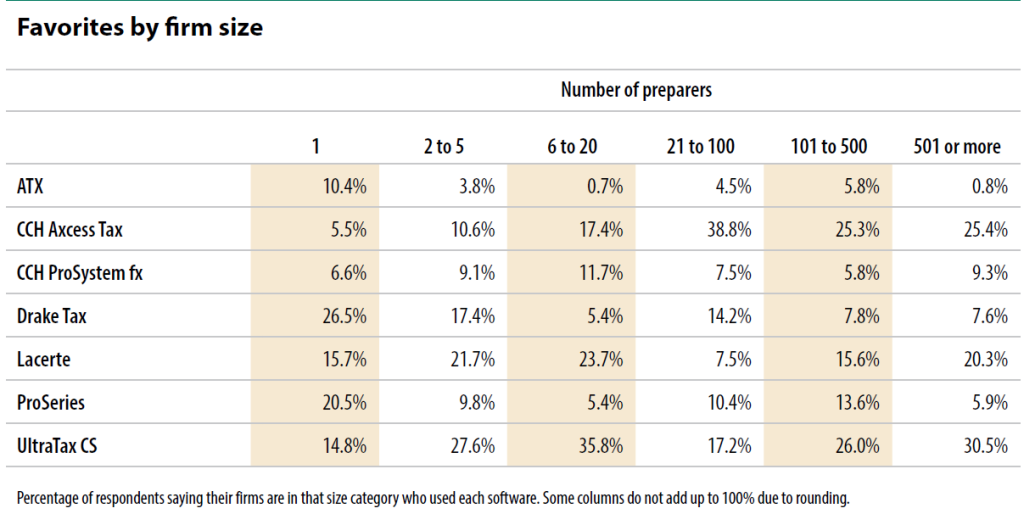
Looking at these figures the other way, with each product’s profile of firm sizes, is in some ways more revealing (although not shown). ATX, for example, because of its fewer number of users, is not highly represented in any of the columns of “Favorites by Firm Size,” but its user profile favors sole practitioners (56.6%) even more strongly than that of Drake Tax (46.5%). And it puts UltraTax CS’s adoption into better perspective to know that, despite its representation in 30.5% of the largest firms — those of more than 500 preparers — that cohort made up only 8.9% of its user base.
Ratings
By the broadest measure, “overall rating,” Drake Tax and Lacerte led with an average of 4.4 (with 5 being the most favorable). CCH Axcess Tax trailed on this question with 4.0 (see the table “Overall Ratings”). Another general attribute, ease of use, was more evenly distributed, with ATX, Drake Tax, Lacerte, and ProSeries all registering 4.4 (but with CCH Axcess Tax again below the average at 3.6).
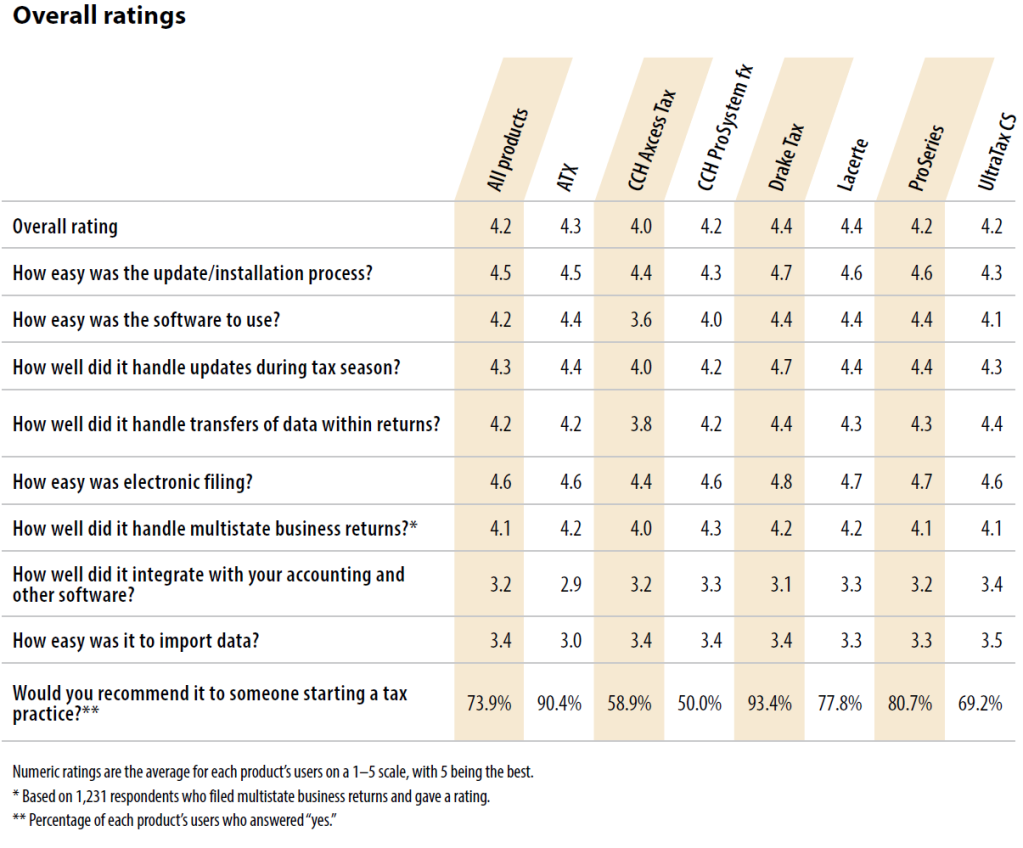
The applications’ handling of a frequent tax season woe, on–the–fly software updates — often to incorporate ill–timed IRS guidance — was surprisingly well regarded. Here, Drake Tax was a standout with a 4.7 rating, well above the 4.3 average for all products. Drake Tax also scored well with another 4.7 for ease of updating and installation, although here the differences among products were muted, with a 4.5 average for all seven. Disaffection was most pronounced across the board for importing data and for integration with other software. For importing data, only UltraTax CS with 3.5 exceeded (and only slightly) the all–products average of 3.4. ATX lagged on this question at 3.0. ATX also trailed on the integration question with 2.9, where again, UltraTax CS led with 3.4.
Asked whether their software would be suitable for a new practice, 93.4% and 90.4% of users of Drake Tax and ATX, respectively, said “yes,” which correlates with those products’ adoption by smaller firms (see the table “Favorites by Firm Size,” above).
Top likes and dislikes
Each year, the survey asks respondents what they like best and least about their software, and this year’s tally for the nine traits follows a familiar pattern. Up to three choices were permitted (see the table “Top Likes”).
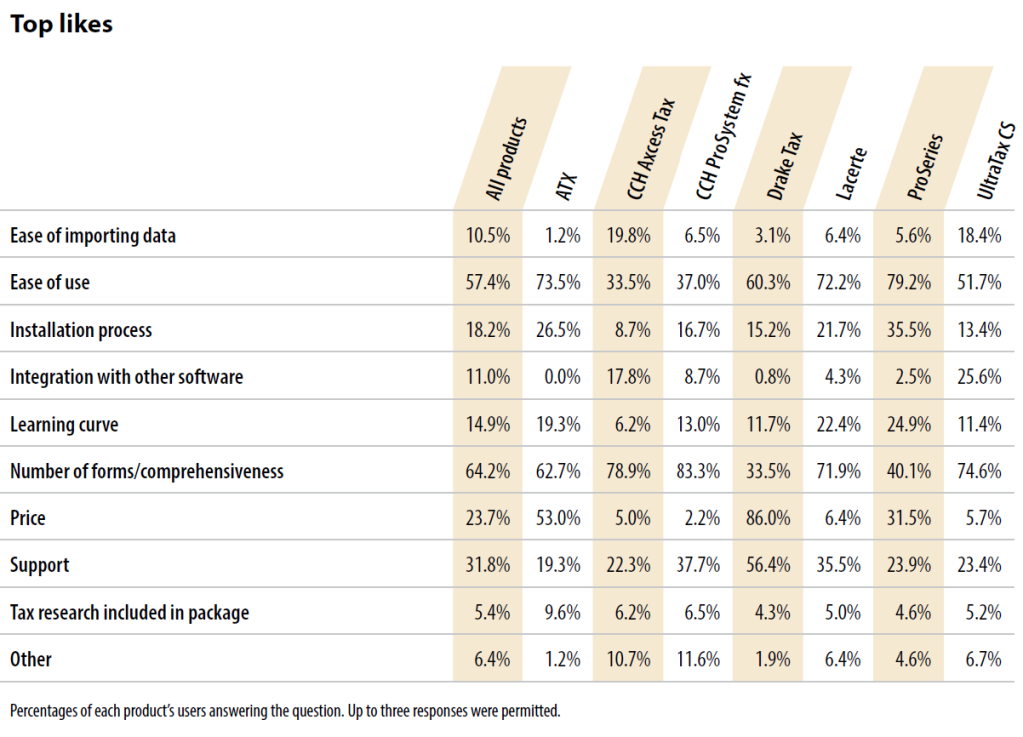
Price is a sore spot for most users of most products. But Drake Tax’s price was among its most–appreciated features, by 86% — more than any trait for any product. Number of forms/comprehensiveness tends also to be a differentiator; 83.3% of CCH ProSystem fx’s users and 78.9% of CCH Axcess Tax’s considered its performance in this regard a leading virtue. A related question, not shown in the tables, was whether the software contained all the forms respondents needed. Users of CCH ProSystem fx and CCH Axcess Tax answered “yes” 89.8% and 85.9% of the time, respectively, but UltraTax CS was still higher at 92.1%. Despite relatively few (33.5%) of Drake Tax users picking number of forms/comprehensives as among its strongest points, 83.7% of them said its number of forms was sufficient. Users of ProSeries were the most likely to say it did not contain all needed forms (31.8%), and hence it’s no surprise that feature was named as a top like by only 40.1% of users (with Drake Tax trailing at 33.5%).
Satisfaction with the software’s customer support in most cases doesn’t tend to register highly, except for Drake Tax, with 56.4% of its users this year liking it. Nearly 80% of ProSeries users liked its ease of use, the highest percentage for that aspect.
Among the 6.4% of respondents who wrote in some other top like, many in some way expressed the more philosophical advantage of familiarity. Some version of “I’ve used it for decades” was often seen or, as one user of CCH ProSystem fx put it, “I have lots of muscle memory.”
Top dislikes offered a clear mirror image from likes with regard to price. Only 10.6% of Drake Tax’s users faulted it and only 35% of ATX’s, while CCH ProSystem fx, Lacerte, and UltraTax CS all got a scowl from over 80% of their users (see the table “Top Dislikes”).
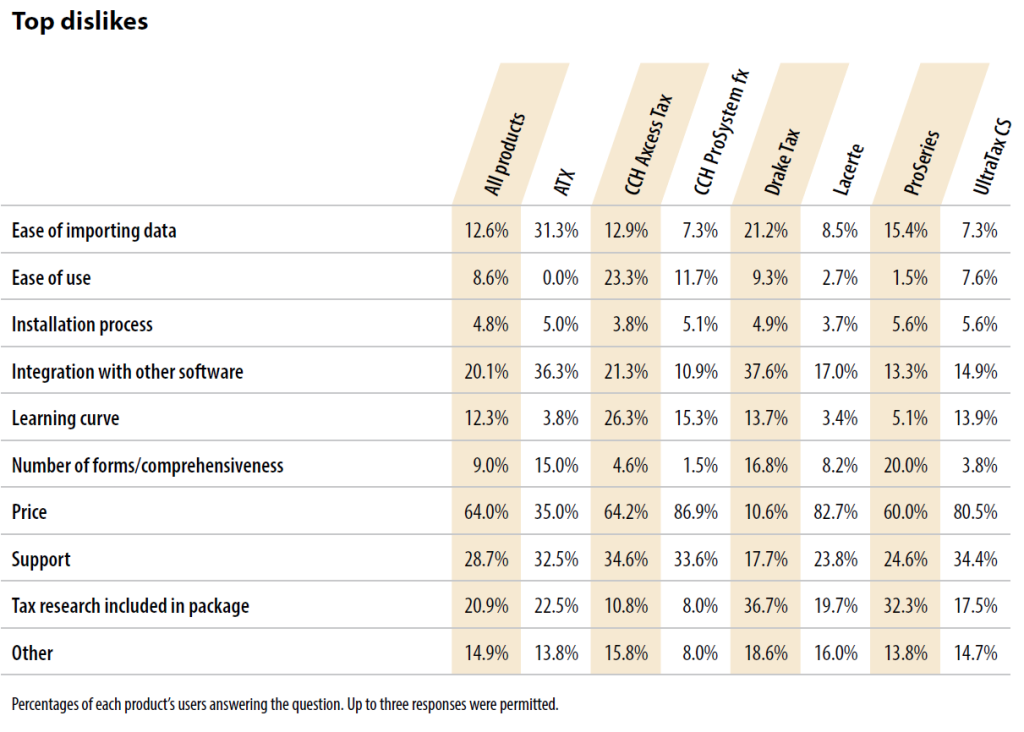
Nearly 15% of users wrote in an “other” top dislike. As mentioned above, updates to the software frequently rankle; 20 of these write–ins concerned them. Thirty–nine custom complaints concerned state returns, many of them multistate (cf. “How Well Did It Handle Multistate Business Returns?” in the “Overall Ratings” above). Four respondents apparently felt one opportunity wasn’t enough to convey their dislike of the software’s price, as with one user of CCH ProSystem fx who selected it from the list and then wrote in “Price Price Price.”
Technical support and training
Besides the results for user support as a top like or dislike discussed above, the survey also asked directly about how technical support was obtained from the software vendor and its perceived quality. Close to three–quarters of respondents needed support (see the table “Technical Support”).
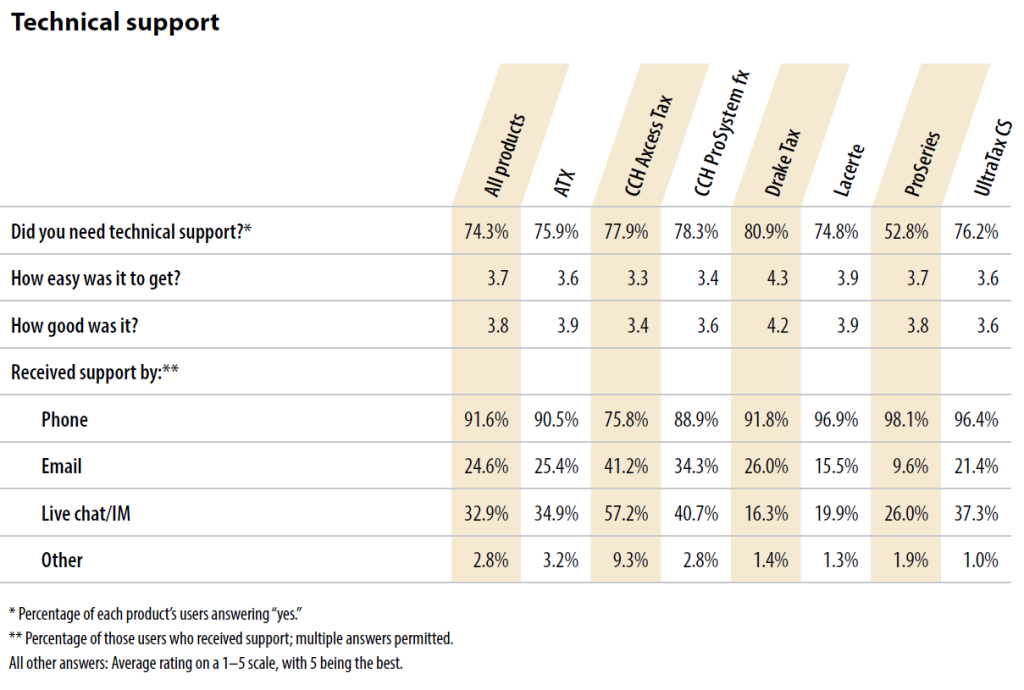
Top ratings for tech support, both for its quality and ease of obtaining it, went to Drake Tax, at 4.2 and 4.3, respectively. As in previous years, the telephone was the principal means of getting support for all brands. After several years of increasing in usage, other methods, including email and live chat, seem to have leveled off this year.
To another technology–related question, whether they ran the software on the cloud or on a local network or drive, 92.3% of CCH Axcess Tax’s users confirmed that product’s advertised cloud operation. More than 94% of users of ATX and CCH ProSystem fx accessed it on their own drive or network.
Less than half of respondents, 41.2%, received any training in how to use their software. This percentage was highest for CCH Axcess Tax at 65.5%, although, on average, they didn’t consider its quality very high, rating it at 3.4, the lowest of the seven products, all of which averaged 3.8. The 48.1% of Drake Tax users who received training rated it the most highly at 4.4.
Tax practice operation
This year, the survey asked several questions relating to how respondents’ tax practices operate, including the use of AI and other technical tools and software for clients’ tax planning.
Use of AI and other technical tools
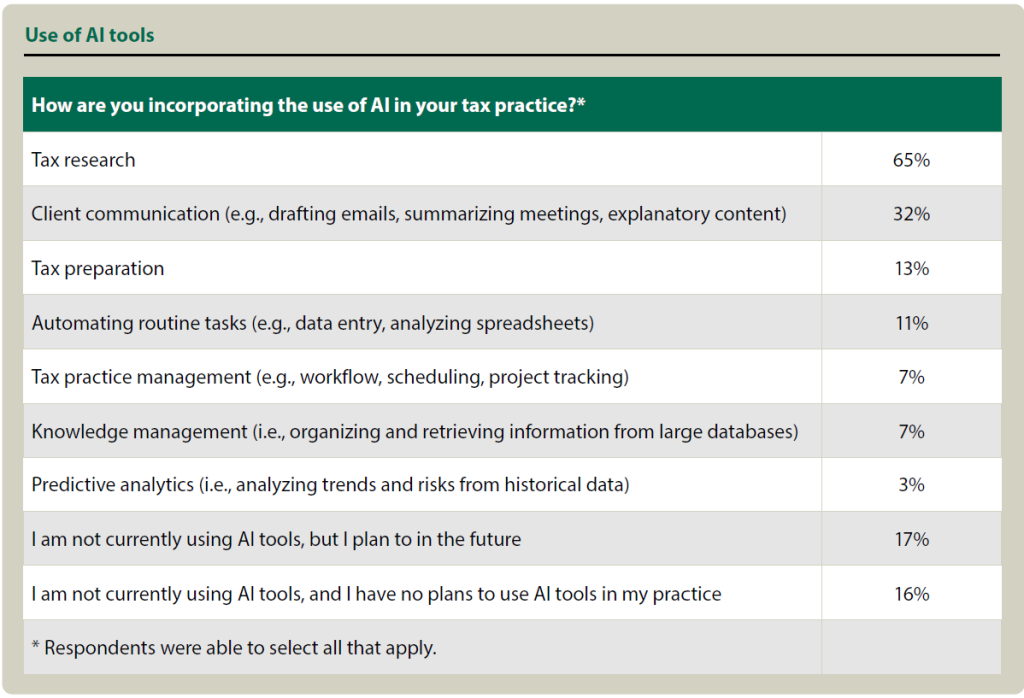
The survey inquired about respondents’ use of AI in their firms, a topic that has gained much attention recently, mostly from the standpoint of managing risks from its use in tax practices and by taxing authorities.1 These results are from all respondents, not just users of the seven “major” products. Sixty–five percent of respondents said they are using AI in tax research, followed by client communication (32%). Only 16% said they had no plans to use AI in their practices. Notably, this latter percentage fell considerably from when the same question was asked a year earlier. In 2025, 24.3% of respondents said they had no plans to use AI. For other current uses, see the table “Use of AI Tools.”
Respondents were also asked whether they used other technology tools or applications to review tax returns to highlight potential planning opportunities for clients, but nearly all respondents (93%) said they did not, representing perhaps an opportunity for learning and adoption. Of the listed applications, Holistiplan was reportedly used by 2% of respondents. The software, produced by Holistiplan LLC, supports tax, financial, and estate planning. Five percent of respondents said they used some other tool or application for this purpose.
Other services
Twenty percent of respondents said they are expanding the types of services they offer clients. Of those respondents, 75% identified tax advisory services as an area of expansion. Other areas selected included client advisory services (55%); estate, trust, and gift financial planning (42%); CFO/project staffing (31%); retirement financial planning (30%); investment financial planning (19%); state and local tax (16%); and not–for–profits (13%).
Tax planning software
Thirty–seven percent of respondents said they also use a tax planning software application in their practice, although relatively few selected any of the 10 products the survey identified. Nine percent of respondents said they used Planner CS, followed by Bloomberg Income Tax Planner with 7%. Eighteen percent of respondents said they used some tax planning application other than those listed.
Choosing the right tool
Sometimes, as for the 2025 tax year, changes and new provisions in the Internal Revenue Code are sudden and far–reaching.2 Despite such innovations, the craft and discipline of tax return preparation largely retains most of its same routines and procedures from year to year. CPA tax preparers can generally depend on the applications discussed here for much of that stability. For some, these survey findings might prompt a decision to switch. Others may derive some confidence that, all things considered, their chosen tool will keep on serving them well.
Footnotes
1See, e.g., Werfel, “A Risk Framework for AI Use in Tax Administration and Preparation,” in this issue of The Tax Adviser, also Waggoner, “IRS Outlines AI Risks, Circular 230 Duties for Tax Practitioners,” The Tax Adviser (June 26, 2026).
2Due to passage of the law known as the One Big Beautiful Bill Act, H.R. 1, P.L. 119-21.
Contributor
Paul Bonner is The Tax Adviser’s editor-in-chief. For more information about this article, contact thetaxadviser@aicpa.org.
MEMBER RESOURCES
Webcasts
Tax Practice Quarterly: 2027 Future-Focused Tax Practice
Tax Practice Quarterly: Navigating Technology for Tax Practitioners in 2027
Websites
Artificial Intelligence (AI) Tax Resource Center
For more information or to make a purchase, visit aicpa-cima.com/cpe-learning or call 888-777-7077.