Transferring accounts receivable and liabilities to a new corporation
The transfer of accounts receivable and accounts payable by a sole proprietor or other transferor to a new corporation usually will not create problems if both the transferor and the corporation use the accrual method of accounting. If the transferor uses the cash method and the corporation will be using the accrual method, it might not be advantageous to transfer the receivables and payables, as some uncertainty exists regarding proper treatment.
Benefiting from the transfer or retention of accounts receivable
Unrealized accounts receivable of a cash–basis sole proprietor can be transferred in a Sec. 351 transaction to a newly formed cash–basis corporation without having the sole proprietor recognize income. The cash–basis corporation recognizes income when it collects the receivables.
The sales that produced the accounts receivable are made by, but not taxed to, the cash–basis proprietorship. Therefore, the transfer of the cash–basis receivables could give rise to some tax savings if the corporation’s effective tax rate is lower than the shareholder’s. The IRS’s position is that this type of transfer does not effectively transfer to the corporation the tax burden incident to those receivables (Briggs, T.C. Memo. 1956–86). The courts have not always agreed with the IRS’s position. Fortunately, the IRS has acquiesced in some cases (Kniffen, 39 T.C. 553 (1962)), indicating that this type of transfer is relatively risk free.
>Sec. 351 will not apply in situations where the sole proprietor is determined to have assigned income to the corporation by building up the receivables balance shortly before the transfer in order to minimize the amount of income reported on an individual tax return (Rev. Rul. 80–198). However, the incorporation of a cash–basis proprietorship or partnership in a Sec. 351 transfer may present some opportunity to minimize proprietorship or partnership income by shifting the taxable income to the corporation. When accounts receivable are high relative to accounts payable, incorporating effectively shifts the tax burden to the corporation. Shifting the tax burden may be even more advantageous, given the 21% statutory corporate tax rate and the potential for a lower average effective tax rate, if favorable permanent tax adjustments are in place.
In some cases, accounts receivable should be retained by the organizer and collected outside the corporate structure. Cash could be retained by the organizer and loaned to the corporation as needed. Once cash or other assets are contributed to a corporation, it is difficult to transfer them back to the shareholder without triggering taxable income to either the shareholder or the corporation. However, the legal and business consequences of keeping assets outside the corporation must also be considered.
Benefiting from the transfer or retention of accounts payable
The sole proprietor may transfer accounts payable and other accrued liabilities with its assets. Any liability whose payment by the proprietor would give rise to a deduction or increase the basis of an asset is excluded in determining whether liabilities exceed basis at the time of the transfer (Sec. 357(c)(3)). Such liabilities would normally include the accounts payable and accrued liabilities of a cash–basis taxpayer.
The IRS has ruled that if the incorporation is bona fide and the new cash–basis corporation carries on an active business, it will obtain a deduction when it pays the payable (Rev. Rul. 80–198). Although the IRS will generally uphold the position it took in this ruling, it is still possible the IRS will take a contrary stance if it determines that the assignment–of–income or the clear–reflection–of–income doctrine applies or that the transfer’s purpose was tax avoidance.
There is some uncertainty about the deductibility of the payable when it is later paid by an accrual–basis corporation. Unfortunately, Rev. Rul. 80–198 does not address the issue when the transferee is on the accrual basis. The IRS has successfully defended its position that the deductibility of the underlying expenses by the transferee corporation was not allowed because the expenses were part of the acquisition cost of the transferor’s assets and were not the transferee’s own deductible expenses (Holdcroft Transportation Co., 153 F.2d 323 (8th Cir. 1946)). This position results in the expenses not being deducted because the proprietor, which incurred but did not pay the expenses, would also not be allowed a deduction. However, the IRS did not follow Holdcroft Transportation Co. where a liability for environmental remediation of property the corporation received in a Sec. 351 transaction was assumed by the corporation (Rev. Rul. 95–74). In that ruling, costs the corporation would incur for environmental remediation of the transferred land would have been deductible in part and capitalized in part had the proprietor continued its manufacturing business and incurred the remediation costs.
Example 1.Incorporating a cash–basis business and transferring accounts receivable and accounts payable to an accrual–basis corporation: M operates a computer consulting business as a sole proprietorship. She files Schedule C, Profit or Loss From Business (Sole Proprietorship), using the cash method. She is incorporating her business. The new corporation will use the accrual method of accounting. Because all but a few thousand dollars of her receivables are collected before year–end, she does not anticipate this will accelerate taxation of income. The table “M’s Sole Proprietorship Balance Sheet” is an accrual–basis balance sheet for the business as of the end of the year.
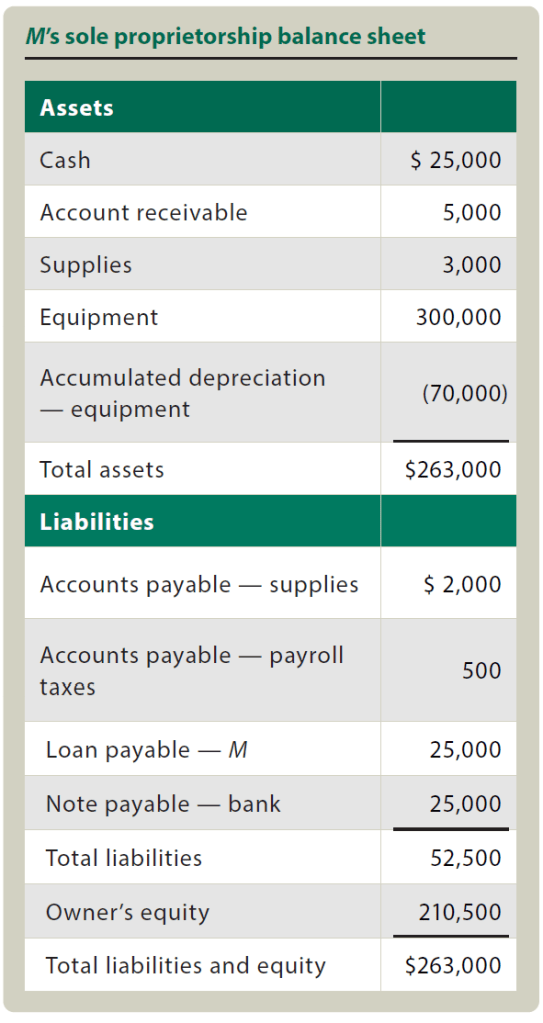
The transfer of the receivables to the corporation does not cause a problem. The corporation will include them in income as they are received. However, the accounts payable are a different matter. If the IRS’s position is that the deductibility of the underlying expenses by the transferee corporation is not allowed because the corporation was not the taxpayer that incurred the expenses, this position would result in a complete disallowance of the deductibility of the expenses. Because M could deduct the supplies or payroll taxes had she paid for them, the corporation can deduct the expenses when economic performance occurs for the items. Alternatively, M could retain enough of the cash–basis receivables to pay the cash–basis payables rather than transfer the payables to the corporation, thereby assuring deductibility.
Tax benefits can be gained by transferring accounts receivable to the corporation but retaining the accounts payable. For example, transferors that retain accounts payable will be able to deduct the expenses arising from the payables on their personal tax returns (Schedule C or E, Supplemental Income and Loss) before the corporation is required to report income on its tax return. However, the transferor should be prepared to show that there was a business reason for retaining the accounts payable (e.g., the transferor may claim that they wanted the new corporation to have sufficient working capital to operate independently, thus burdening the corporation with as little debt as possible). If the transferor retains accounts payable without a valid business reason, the IRS may assert a tax–avoidance purpose because the transfer separates income from related expenses, which violates the matching principle for GAAP and the income principle for tax.
Taking a deduction for the payment of assumed liabilities
Generally, if the payment of an obligation of a preceding property owner is made by a person acquiring the property, the payment is not a currently deductible expense and must be capitalized. However, for certain liabilities transferred to a controlled corporation in a Sec. 351 transfer, this may not be the case. In one ruling, the IRS allowed a current deduction for vacation pay liabilities of the previous owner when paid by a transferee–controlled corporation (Technical Advice Memorandum 9716001). The IRS based its conclusion on the fact that the transferor corporation had transferred substantially all of the assets and liabilities to the transferee in exchange for the transferee’s stock; the vacation pay would have been deductible by the transferor; and there was a valid business purpose for the transfer of the vacation pay liability (maintaining employee morale by allowing the transferred employees to take their vacation days). In addition, the IRS found that the transfer was not motivated by tax avoidance.
Accounting for contingent and assumed liabilities paid by the corporation
Many times following a Sec. 351 transfer, the transferee corporation may pay a liability that had been incurred prior to incorporation but did not meet the standards of an accruable liability at the time of incorporation. If the payment of the contingent liability can be construed by the IRS as principally benefiting the shareholder rather than the corporation, it might be considered a constructive dividend payment to the shareholder. Such a payment would not be deductible by the corporation but would be income to the shareholder and may or may not be deductible by the shareholder.
An example of such a contingent liability is the legal cost incurred in defense of a tax fraud case brought against a taxpayer for a year prior to incorporation but incurred after incorporation. In a Tax Court case, it was determined that the payment of such expenses by the corporation constituted a constructive dividend to the shareholder (Hood, 115 T.C. 172 (2000)). However, the court did allow the shareholder a Schedule C deduction for these expenses. The IRS’s position in characterizing the payment of the expenses as a constructive dividend was that the legal costs were not ordinary and necessary business expenses of the corporation but were expenses of the shareholder. The court held that in order to secure a deduction at the corporate level, it must be shown that the corporation primarily benefited from the payment of the expenses.
A corporation can in some cases deduct the expenses it explicitly assumes in a Sec. 351 transaction (if those expenses are otherwise deductible). Therefore, legal documents pertaining to a Sec. 351 transfer should contain language to the effect that the transferee corporation assumes all contingent liabilities, including those pertaining to the contest of asserted tax deficiencies or fraud charges, or any potential environmental contamination liabilities asserted against the prior unincorporated business. While this language might not be the determinative factor in these cases, it may prove helpful in mounting an effective defense.
Avoiding abusive tax shelter transactions
An area in which great caution should be exercised pertains to the use of Sec. 351 transfers as part of what the IRS considers abusive tax shelter transactions. One example, identified in Notice 2001–17, involves the transfer of high–basis assets to a controlled corporation and the transferee corporation’s assumption of a contingent liability that the transferor has not yet taken into account for federal income tax purposes.
The intent of the transaction is to have the transferor receive a high basis in the transferee’s stock while the fair market value (FMV) of the stock is much lower due to the existence of the contingent liability. The transferor can then sell the stock for its FMV, generating an immediate loss for the transferor. In addition, the transferee may take a deduction for the contingent liability when and if it is finally paid.
Sec. 358(h) provides that, after the application of Sec. 358, if the basis of property received in a Sec. 351 exchange exceeds the FMV of the property, the basis of stock or other nonrecognition property received must be reduced by the amount of the liabilities that are assumed in the exchange (including the value of any contingent liabilities assumed) and to which Sec. 358(d)(1) does not apply. This provision does not apply when the trade or business associated with the liability is transferred along with the liability or substantially all of the assets with which the liability is associated are transferred along with the liability as part of the exchange.
Example 2.Reducing basis in transferor’s stock: A Corp. transfers selected assets (not comprising a trade or business) with an adjusted basis and FMV of $100,000 to B Corp. in exchange for 100% of B’s stock in a Sec. 351 exchange. B also assumes $30,000 of A’s contingent liabilities. Normally, the $30,000 assumed by B would be treated as money received by A, reducing A’s basis in stock received (Sec. 358(d)(1)). However, if B is able to deduct the $30,000 liability (i.e., it is a Sec. 357(c)(3) liability), then A does not have to reduce its basis in stock received (Sec. 358(d)(2)).
Without Sec. 358(h), a double deduction for the same liability could occur. B would be allowed to deduct the $30,000 liability when it was paid (if deductible). In addition, A would also be able to deduct the $30,000 when it sells its stock because it did not have to reduce its basis in the B stock because of Sec. 358(d)(2).
The basis of the stock received by A ($100,000) exceeds its FMV ($70,000), resulting in the application of Sec. 358(h)(1). A must reduce its basis in B stock to $70,000 (by the amount of liabilities assumed, but not below its FMV).
Under Sec. 357(b)(1), if, taking into consideration the nature of the liability and the circumstances in the light of which the arrangement for the assumption of the liabilities was made, it appears that the principal purpose of the taxpayer with respect to the assumption was to avoid federal income tax on the exchange, or there was not a bona fide business purpose, then the assumption (in the total amount of the liability assumed pursuant to the exchange) is, for purposes of Sec. 351, considered as money received by the taxpayer on the exchange.
In Coltec Industries, Inc., 62 Fed. Cl. 716 (2004), the Court of Federal Claims considered four principles in making its determination of whether a taxpayer’s intent was tax avoidance and/or a bona fide business purpose existed when transferring liabilities to a corporation in an otherwise tax–free transfer. First, business purpose is to be examined narrowly with respect to the assumption of a liability and avoidance of income tax on the exchange. Second, the closer the nature of the liabilities is to the customary business of the transferee and its continued viability, the more likely it is that Sec. 357(b)’s business–purpose test will be satisfied. Third, if the liabilities were incurred well before the transfer of stock, the more likely it is they will be considered as incurred for a business purpose and not tax avoidance. Fourth, the longer the lifespan of the corporate vehicle utilized and term of any promissory notes issued, the more likely a court will find the transaction to have been undertaken for a business purpose.
The IRS appealed the decision to the Federal Circuit in Coltec Industries, Inc., 454 F.3d 1340 (Fed. Cir. 2006). The Federal Circuit reversed the Court of Federal Claims, holding that the overall transaction lacked economic substance. The Federal Circuit found that, in order to have economic substance, the assumption of liabilities must also effect a real change in the flow of economic benefits, provide a real opportunity to make a profit, and appreciably affect the taxpayer’s beneficial interest aside from creating a tax advantage.
In addition to Sec. 358(h), Notice 2009–59 warns that the IRS may impose penalties on participants, advisers, promoters, or return preparers who become involved in these arrangements and fail to meet the disclosure and reporting requirements of Secs. 6011 and 6111. Additional penalties for understatements related to reportable transactions may apply (Secs. 6662A and 6707A).
Requesting an IRS ruling
If the amount of payables to be transferred is significant, the uncertainty regarding future deductibility might warrant requesting a ruling.Consistent with Rev. Rul. 80–198, the IRS may permit the transferee corporation to deduct transferred payables when paid in a bona fide Sec. 351 incorporation of an ongoing cash–basis business, particularly where the parties agree that the expenses will be deducted only by the transferee and not by the transferor.
Contributor
Shannon Christensen, J.D., MBT, is an executive editor with Thomson Reuters Checkpoint. For more information about this column, contact thetaxadviser@aicpa.org. This case study has been adapted from Checkpoint Tax Planning and Advisory Guide‘s C Corporations topic. Published by Thomson Reuters, Frisco, Texas, 2026 (800-431-9025; tax.thomsonreuters.com).