The hidden costs and tax burdens of European waterfalls
Editor: Robert Venables, CPA, J.D., LL.M.
Entities taxed as partnerships under Subchapter K of the Internal Revenue Code are generally considered to provide the most flexibility for interesting or exotic distribution and allocation provisions. So long as they abide by the partnership allocation requirements under Sec. 704 (discussed later), there are no limits to the types of units that can be created, and units may share partnership earnings in different ways throughout the life of the partnership, depending on several factors including the source and timing of earnings and the partnership’s net earnings to date. This flexibility makes a partnership the ideal structure for a private fund (including funds investing in private equity, venture capital, private credit, and hedge funds). Flexibility in allocation provisions allows a private fund to incentivize its managers in creative ways while also benefiting its limited partners (LPs) or investors.
Generally, earnings sharing between fund managers/founders and investors will be structured in one of three ways:
- An incentive fee paid to fund managers at regular intervals based on fund performance;
- An “American” distribution waterfall, which measures the success of each individual investment on a stand-alone basis and allows fund managers to share in proceeds once the return on investment has met certain hurdles; or
- A “European” distribution waterfall, which is similar to an American waterfall in that fund managers share in returns on investments over certain hurdles. In a European waterfall, however, such hurdles are set on the entire investment fund rather than on an investment-by-investment basis.
While partnerships offer flexibility to allocate partnership earnings in interesting ways, Sec. 704 provides standards for partnership income allocations that must be followed for the partnership or LLC agreement provisions to be permitted and respected. If such standards are not followed, the partnership risks a required reallocation of items of income, deduction, gain, loss, or credit (income) based on each partner’s deemed interest in partnership profits (Regs. Sec. 1.704–1(b)(1)(i)). Both American and European waterfalls often adopt a “targeted capital account” allocation methodology, which clashes with Sec. 704 in certain ways. This item focuses on how a targeted capital account allocation coupled with a European waterfall may create unexpected results.
Targeted capital account allocations are already on thin ice
The income allocation requirements for partnerships are contained in Sec. 704, specifically, in Regs. Sec. 1.704–1(b). Under the regulations, the partnership allocations must have “substantial economic effect,” which, in part, requires the partnership to maintain appropriate partner capital accounts (Regs. Sec. 1.704–1(b)(2)(ii)(b)(1)) and to make liquidating distributions in accordance with such capital accounts (Regs. Sec. 1.704–1(b)(2)(ii)(b)(2)).
These requirements are commonly achieved by a partnership’s first determining how income will be allocated to partners, then making distributions according to each partner’s resulting capital account. Targeted capital account allocations, meanwhile, have the opposite approach, in which each partner’s ending capital account (their “targeted capital account”) is established based on how partners would share in the proceeds from liquidating the partnership’s assets for their “carrying value,” then allocating current–year income in a way that most closely aligns each partner’s capital account with their respective targeted amount. The amount considered carrying value may differ for different purposes; for example, carrying value for financial statement purposes may include unrealized gains and losses, while for tax purposes, it should agree to the tax/Sec. 704(b) basis of the partnership’s assets. These differences may create differences in assumed proceeds available in a distribution waterfall.
Whether a targeted capital account allocation is considered to have substantial economic effect under Sec. 704(b) due to its backward application has not been addressed specifically in published guidance. Given the questionable nature of its application, it is imperative that partnerships that use this allocation method apply it consistently as support of the method’s results and validity. If this allocation method is not respected under Sec. 704, a separate determination of each partner’s interest in the partnership could result in allocations that are substantially different than their intended earnings sharing.
The intention of European waterfalls and targeted capital account allocation implementation
The rationale for implementation of a European waterfall is straightforward: A fund manager or founder prefers to implement a sharing policy that allows them to share in earnings only once the entire fund has achieved a certain return for its investors. This type of waterfall is preferred by investors, as it avoids potentially rewarding fund managers for one–off successful investments and instead incentivizes consistent returns on all committed capital. The liquidation provisions for funds with a European waterfall will commonly provide for some variant of liquidating distributions in the following order of priority:
- To LPs or investors until 100% of contributed capital has been returned.
- To LPs or investors until a certain rate of return has been achieved (commonly referred to as “preferred return,” and this can fluctuate based on the type of fund and its investments).
- To the general partner (GP) or fund managers until they meet a minimum share of fund earnings (commonly referred to as the “GP catch-up,” and rates generally range from 10% to 30%).
- Remaining proceeds are split between the LPs and GP based on an agreed sharing ratio that will usually provide the GP with the same share that they were eligible to catch up to in Step 3.
When using a targeted capital account allocation method, a partnership must determine each partner’s targeted capital or share of liquidation proceeds as if all assets were disposed of for their carrying value. This is determined by first establishing the value that would be available for distribution and then applying those proceeds sequentially until each step in the waterfall has been filled. The partnership will then allocate its income for the period in a way that aligns each partner’s capital account before income allocation with their targeted capital account; effectively, the income allocation is a “plug” to achieve the desired result.
Targeted capital account allocation timing issues for fund managers
As fund managers are not entitled to a share of distributions from a fund with a European waterfall until investors’ capital is repaid with a preferred return (i.e., until Step 3 above), they may expect any allocation of partnership taxable income to be similarly delayed to later realization events. However, this assumption may not reflect appropriate allocations, depending on the investment fund’s facts and circumstances — in fact, incentive allocations of income are often required to occur prior to distributions to fund managers if the targeted capital account allocation method is being followed appropriately.
As this concept is counterintuitive, an example will best illustrate how this result occurs and why it is economically appropriate:
Example: Fund A is a limited partnership investment fund with a single investor/LP and a single GP. The LP contributes $100 to Fund A, which is entitled to a $10 preferred return (which represents a flat 10% preferred return over the life of the investment), while the GP makes no contribution. Fund A provides for the following European distribution waterfall:
- First, to LP to the extent of committed capital ($100);
- Second, to LP to the extent of the unpaid preferred return ($10);
- Third, to GP until the allocation of 20% of the “preferred return” ($2); and
- Fourth, split between LP and GP — 80%/20%, respectively.
In year 1, the LP contributes $100, and Fund A funds two separate investments in companies taxed as corporations — Corp. X for $20 and Corp. Y for $80. No other activities occur in year 1. In year 2, Fund A disposes of 100% of its interest in Corp. X for $72 — a $52 gain — and no other activities occur. Following the distribution waterfall, the $72 is distributed to the LP under Step 1, a return of capital. At the end of year 2, Corp. Y maintains a tax and fair market value of $80.
The GP may assume that because it did not receive an incentive distribution, it will similarly not receive an income allocation. However, the steps of the targeted capital allocation must be followed to determine income allocations for year 2. Fund A has remaining distributable proceeds of $80 (the tax carrying cost of Corp. Y). See the table “Determined Targeted Capital Accounts and Allocations for Year 2.”
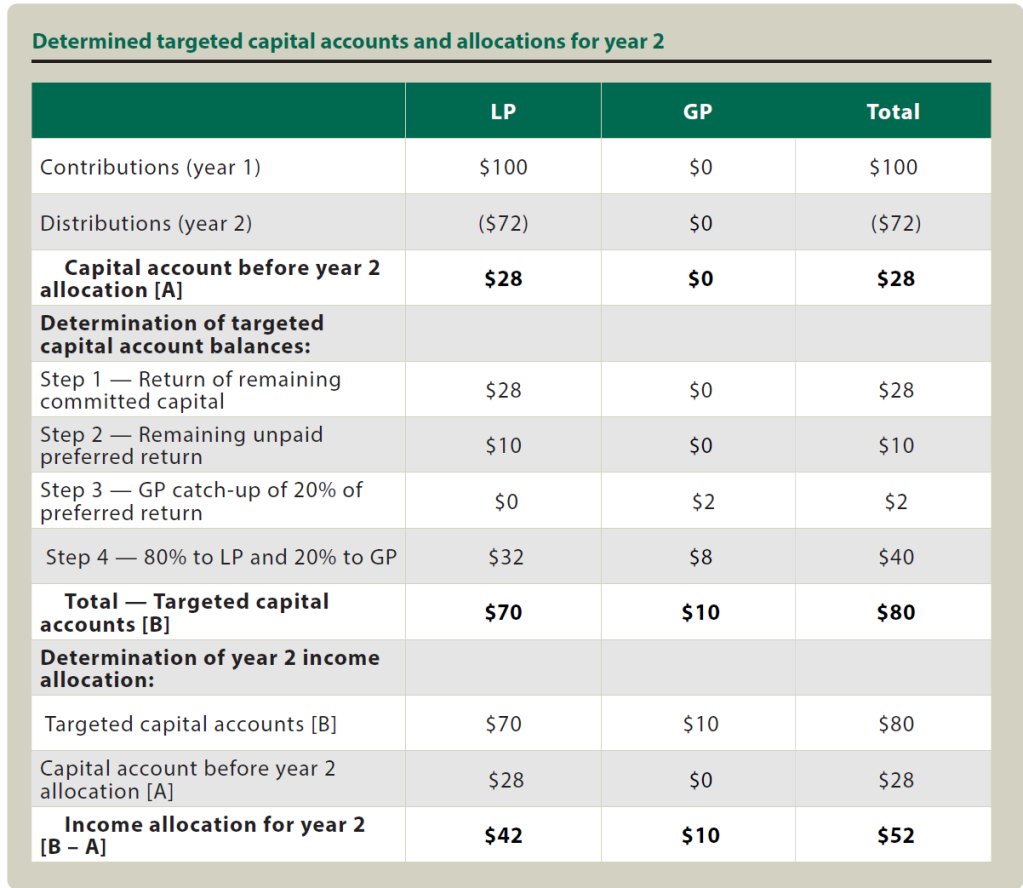
While the GP is not entitled to share in the proceeds from the sale of Corp. X based on the execution of the European waterfall, it is still allocated income of $10 in year 2from the sale of this investment, based on the targeted capital account allocation approach. While this result may be unexpected, it is economically appropriate and can be illustrated by looking ahead to future events of FundA:
Fund A has no activity in years 3 and 4, and in year 5, Fund A disposes of its investment in Corp. Y for $80. Fund A would not recognize any taxable income in year 5 ($80 sale price, less $80 tax basis = $0). Ten dollars of the proceeds from this sale would be distributable to the GP through the European waterfall.
If Fund A did not allocate GP $10 from the sale of Corp. X in year 2, the year 5 distribution would result in GP’s having a negative capital account. Furthermore, if Fund A had allocated LP the entire $52 gain from the sale of Corp. X in year 2, LP would have recognized more income from its fund investment ($52) than its total economic gain through its partnership investment ($142 of distributions, less $100 of contributions = $42).
These events illustrate why the allocations in the targeted capital account approach, while not desirable for the GP, would be appropriate. This result is undesirable to the GP for several reasons. First, the allocation of taxable income would create a tax burden for which the GP has not received proceeds to pay (often referred to as “phantom income”). Second, the GP’s internal rate of return on eventual proceeds will be hampered by the outlay of tax payments in year 2. Third, the character of income in year 2 may not be beneficial to the GP, particularly if Sec. 1061 applies. Sec. 1061 may recharacterize long–term capital gains allocated to partners as short–term capital gains if a partner’s interest is considered an “applicable partnership interest,” which is effectively a carried interest in an investment fund (see Sec. 1061 definitions for additional details).
To alleviate the tax burden on phantom income allocations, investment funds often implement a tax distribution provision of some kind. Such provisions come in many iterations, but in effect, they are intended to help ensure partners are not subject to a tax burden from their investment in the partnership without receiving sufficient distributions to pay for those tax consequences. Such a provision could be triggered in several scenarios, including when a fund receives an allocation of income from investments without an associated distribution; when a fund opts to recycle investment proceeds rather than distribute them; and, as in line with the subject of this item, when a partner receives an allocation of income while not currently being entitled to share in distributions. A tax distribution provision will generally permit partners to receive sufficient cash distributions to cover potential tax liabilities associated with the allocation of partnership income, regardless of whether such partners would otherwise have been entitled to a distribution under the fund’s distribution provisions. If partners are not otherwise entitled to a distribution, such tax distributions will likely be considered an advance against future partnership distributions.
While a tax distribution provision may help offset part of the unwelcome consequences that may occur from a targeted capital account allocation under a European waterfall, many caveats apply. The ability to make such distributions is limited to a fund’s cash available for distributions and is generally subject to a manager’s discretion. This effect may be magnified, considering that if a fund manager does not appropriately identify a required GP income allocation and associated tax distribution at the time of an income event, the fund may distribute all proceeds to LPs according to their waterfall and not hold back proceeds necessary to pay tax distributions. Additionally, depending on the way a preferred return is calculated for LPs, the payment of tax distributions to a GP may cause the LPs’ preferred return earned over the life of an investment fund to increase — meaning a potentially reduced return to the GP over the life of the fund.
Regardless of applicable caveats, tax distribution provisions should be well documented and thoroughly considered when events creating income allocations occur; such provisions are key measures that protect the GP as much as they do the LPs of a fund.
How can this result be avoided?
Avoidance of this type of income allocation depends on the provisions in a fund’s operating agreement (limited partnership agreement or LLC agreement, depending on its form). An American waterfall would more naturally avoid this concern by the GP’s being entitled to distributable proceeds for individual investments. American waterfall distributions generally come with or are more likely to trigger clawback provisions, which must also be considered and actively managed. Additionally, agreements may contain options for a GP to waive its right to carry allocations, but this type of waiver may have economic implications that are outside the scope of this item.
If avoidance measures are not available through the operating agreement provisions, a fund should follow the required results of its targeted capital account allocation methodology. Straying from these provisions may cause the already questionable application of this methodology to be considered not in compliance with Sec. 704 requirements. If this determination is made, resulting allocations under the “partner’s interest in the partnership” determination may be unpredictable and could be more inequitable for all parties. The best practice is to understand and forecast these results upon each of the fund’s material income events and identify the income and distribution requirements of such events.
Editor
Robert Venables, CPA, J.D., LL.M., is a tax partner with Cohen & Co. Ltd. in Fairlawn, Ohio.
For additional information about these items, contact Venables at rvenables@cohencpa.com.
Unless otherwise noted, contributors are members of or associated with Cohen & Co. Ltd.