Tax return positions: Required levels of authority
Editor: Robert Venables, CPA, J.D., LL.M.
Most, if not all, tax practitioners have discussed with taxpayers the applicability of potential penalties and interest. This could be in relation to estimated tax payments, extension payments, when a return is filed, or a position reported on a return. However, practitioners may not always contemplate that they themselves could be subject to penalties or other repercussions under various sections of the Internal Revenue Code (IRC). This item focuses on tax return positions and the levels of authority required under the IRC to avoid penalties, highlighting Sec. 6694(a), as well as other professional standards practitioners need to consider.
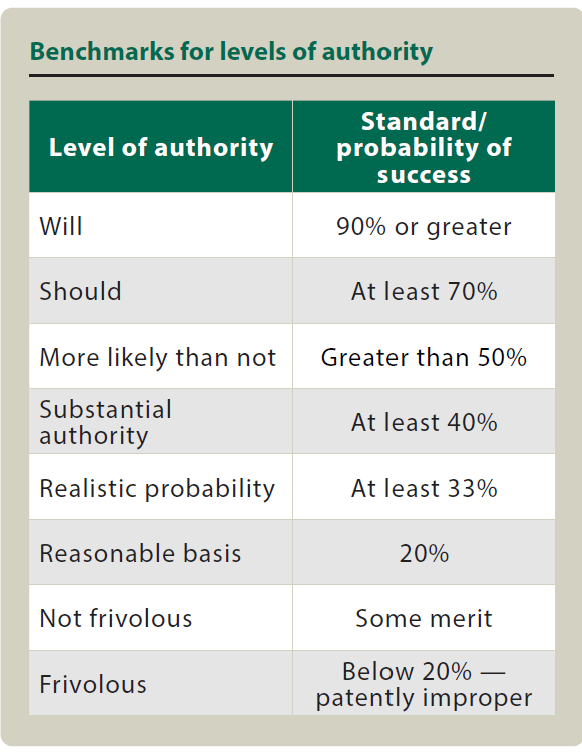
Different terms are often used to describe the confidence level of a tax return position. These terms are based on the probability of success if the position were to be challenged. To somewhat complicate matters, not all of these terms are clearly or specifically defined. However, some of these terms and the corresponding approximate percentages of confidence that are commonly attributed to them are shown in the table “Benchmarks for Levels of Authority,” below, AICPA Tax Section members can download a “Levels of Confidence for Tax Return Positions Chart” for further reference.
Circular 230 and professional standards
Before discussing Sec. 6694, it is important to understand that practitioners may also be subject to other rules, regulations, and standards that must be followed when providing advice or preparing tax returns. Examples include Treasury Circular 230, Regulations Governing Practice Before the Internal Revenue Service (31 C.F.R. Part 10), which governs practice before the IRS, and state licensing agencies for attorneys and CPAs. Each of these governing bodies may have similar but different standards and requirements that practitioners need to consider.
As Circular 230 governs practice before the IRS, practitioners should be fully apprised of its requirements. While a full examination of those regulations is beyond the scope of this item, some sections are worth highlighting. Section 10.22(a)(1) requires a practitioner to exercise due diligence “[i]n preparing or assisting in the preparation of, approving, and filing tax returns, documents, affidavits, and other papers relating to Internal Revenue Service matters.” Section 10.34(a)(1) provides in part that a “practitioner may not willfully, recklessly, or through gross incompetence” sign a tax return or claim for refund or advise a client to take a position on a tax return or claim for refund that contains a position that:
- Lacks a reasonable basis;
- Is an unreasonable position as described in section 6694(a)(2) …; or
- Is a willful attempt by the practitioner to understate the liability for tax or a reckless or intentional disregard of rules or regulations by the practitioner as described in section 6694(b)(2).
A practitioner also must inform the taxpayer of penalties that are reasonably likely to apply to a position if the practitioner advised the taxpayer with respect to the position or prepared or signed the return, as well as on the ability to avoid such penalties with proper disclosure (Section 10.34(c)).
Practitioners, such as CPAs and attorneys, also may have state licensing board standards for tax return positions. Many state CPA licensing agencies, for example, follow the AICPA’s Statements on Standards for Tax Services (SSTSs). The SSTSs also apply to all AICPA members regardless of jurisdiction. SSTS Paragraph 2.1.6 states generally that a member should comply with the standard set by the applicable tax authority; however, subparagraph (a) adds that if no such standard is prescribed, then the “member should not prepare or sign the tax return unless the member has a good–faith belief that the tax return position has at least a realistic possibility of being sustained administratively or judicially on its merits if challenged.” The realistic–possibility standard in the SSTSs may be increased to a higher standard if required by the appropriate taxing authority or could be reduced to a reasonable basis (SSTS ¶¶2.1.6(b) and (c)). Subparagraph (c) specifically allows the reasonable–basis standard to be used if allowed by the taxing authority and the position is appropriately disclosed. Like Circular 230, the SSTSs cover the member’s responsibility to inform the taxpayer of potential penalties and opportunities, if applicable, to avoid such penalties through disclosure to the taxing authority (SSTS ¶2.1.7).
Understatement of taxpayer’s liability by tax return preparer
Like the requirements discussed above, Sec. 6694(a) addresses the level of authority required for tax return positions. This section imposes a penalty on tax return preparers who prepare any return or claim for refund that results in an understatement of liability due to an unreasonable position that the tax return preparer knew or should have known of (Sec. 6694(a)). For purposes of Sec. 6694, the definition of “understatement” is very broad and includes “any understatement of the net amount payable with respect to any tax imposed by this title or any overstatement of the net amount creditable or refundable with respect to any such tax” (Sec. 6694(e)). The penalty is the “greater of $1,000 or 50 percent of the income derived (or to be derived) by the tax return preparer with respect to the return or claim” (Sec. 6694(a)(1)). Depending on the client, this could result in a sizeable amount. Therefore, tax return preparers need to ensure that positions reflected on returns and claims of refunds are reasonable. Like many things with taxes, the definition of “reasonable” will depend on the circumstances.
In general, a position is reasonable if “there is or was substantial authority” for it (Sec. 6694(a)(2)). This standard can be heightened or relaxed, depending on a couple of factors. Sec. 6694(a)(2)(B) lowers the substantial–authority standard to a reasonable basis if the position is adequately disclosed. However, for positions with respect to tax shelters or reportable transactions, the general substantial–authority standard is increased to a more–likely–than–not standard without regard to whether the position was disclosed on the return (Sec. 6694(a)(2)(C)).
While the standards are set forth in Sec. 6694 itself, the regulations provide more context. Sec. 6694 leverages the regulations under Sec. 6662 (applicable to taxpayer accuracy–related penalties) for some of these definitions. Regs. Sec. 1.6662–4(d)(2) lays out their relative stringency. It provides that “[t]he substantial authority standard is less stringent than the more likely than not standard … but more stringent than the reasonable basis standard.” With that in mind, let’s look at how the regulations define each of these standards, starting with the most stringent.
More likely than not: The more–likely–than-not standard is the highest standard required in Sec. 6694 and the easiest to define quantitatively. As the name indicates, this standard is met “if the tax return preparer analyzes the pertinent facts and authorities and, in reliance upon that analysis, reasonably concludes in good faith that the position has a greater than 50 percent likelihood of being sustained on its merits” (Regs. Sec. 1.6694–2(b)). While it is the most stringent of these three standards, it still requires the position to exceed only a 50% threshold.
Substantial authority: The substantial-authority standard is met “only if the weight of the authorities supporting the treatment is substantial in relation to the weight of authorities supporting contrary treatment” (Regs. Sec. 1.6662–4(d)(3)(i)). Unlike the more–likely–than–not definition above, there is no official quantitative benchmark for this definition. Additionally, depending upon the meaning of “substantial,” this definition does not alone indicate that it carries less than a 50% confidence level. However, this regulation goes on to clarify this by acknowledging, “There may be substantial authority for more than one position with respect to the same item.”
Reasonable basis: While reasonable basis is the lowest of these three standards, Regs. Sec. 1.6662–3(b)(3) states it is a “relatively high standard of tax reporting, that is, significantly higher than not frivolous or not patently improper.” It adds that the standard “is not satisfied by a return position that is merely arguable or that is merely a colorable claim.” This regulation goes on to add possibly the clearest definition of how the standard can be satisfied:
If a return position is reasonably based on one or more of the authorities set forth in §1.6662-4(d)(3)(iii) [described below] (taking into account the relevance and persuasiveness of the authorities, and subsequent developments), the return position will generally satisfy the reasonable basis standard even though it may not satisfy the substantial authority standard.
While the reasonable–basis standard may be met with a single authority, depending on its relevance and persuasiveness, some level of support is still required, and a position reported on a reasonable basis requires adequate disclosure to avoid the Sec. 6694(a) penalty. The adequate–disclosure requirements are laid out in Regs. Sec. 1.6694–2(d)(3).
How to determine which level of authority is achieved
Now that we have established the requisite standards and seen at least a broad definition of each, we will look at the factors that go into determining which of these standards a tax return position rises to.
Type of authority: The list of authorities laid out in Regs. Sec. 1.6662–4(d)(3)(iii) is extensive and includes many of the common items that tax return preparers and advisers normally analyze, such as the IRC, regulations, court cases, revenue rulings and procedures, tax treaties, private letter rulings, etc. It also includes items that may be less commonly thought of, such as congressional committee reports, general explanations of tax legislation prepared by the Joint Committee on Taxation, IRS information or press releases, and other administrative pronouncements published by the IRS in the Internal Revenue Bulletin. While the list is expansive, it does not include “[c]onclusions reached in treatises, legal periodicals, legal opinions or opinions rendered by tax professionals” (id.). However, the authorities that these sources relied upon in arriving at their opinions may form the basis for a tax return position. Additionally, authorities do not continue to be authorities if they are overruled or modified.
Relevance and persuasiveness of authority: The relevance and persuasiveness of an authority is based on the type of document, similarity of facts to the taxpayer’s, the analysis used by the authority in reaching its conclusion, clarity of the underlying facts at issue, and age/subsequent developments of the authority. Regs. Sec. 1.6662–4(d)(3)(ii) provides context for these factors through some examples. These include:
- Revenue rulings are accorded more weight than a private letter ruling;
- A case or ruling having some facts in common with the issue is not particularly relevant if it is materially distinguishable on its facts or otherwise inapplicable;
- An authority such as a private letter ruling with deleted information is diminished if the deleted information could affect the conclusion;
- Authority that only states a conclusion is less persuasive than one that reaches a conclusion by cogently relating applicable law to pertinent facts; and
- Less weight is given to older private letter rulings, technical advice or general counsel memorandums, or actions on decisions than more recent ones, especially when such authorities are more than 10 years old.
While it may be necessary in some situations to parse through the various authorities and determine the weight offered by each, not all tax return positions will require that level of detail. The regulations acknowledge that not only can there be sufficient authority “despite the absence of certain types of authority” but also that a tax return position could be “supported only by a well–reasoned construction of the applicable statutory provision” (id.).
Other factors: When evaluating whether a position meets the reasonable–basis, substantial–authority, or more–likely–than–not standard, the probability the return will be audited should not be a consideration. Regs. Sec. 1.6662–4(d)(2) addresses this by providing that “[t]he possibility that a return will not be audited or, if audited, that an item will not be raised on audit, is not relevant.” Thus, the fact that a small number of filed returns are audited cannot serve as the basis, in whole or in part, for meeting any of the standards.
The applicability of an IRC section, regulation, or ruling may differ based on the facts and circumstances of each situation. Often, the facts and other necessary information are obtained by the tax return preparer from the taxpayer and/or outside sources. A tax return preparer may rely in good faith upon this information and “is not required to audit, examine or review books and records, business operations, documents, or other evidence to verify independently information provided by the taxpayer, advisor, other tax return preparer, or other party” (Regs. Sec. 1.6694–1(e)(1)). Therefore, tax return preparers can generally rely on the information they were provided when assessing authorities and making determinations on tax return positions. Limits are placed on a tax return preparer’s ability to rely on such information, however. Specifically, the regulation provides that tax return preparers:
- May not ignore the implications of information furnished to the tax return preparer or known by the tax return preparer; and
- Must make reasonable inquiries if the information as furnished appears to be incorrect or incomplete.
Final thoughts
Tax return preparers should be aware of two other important aspects of Sec. 6694. First, Sec. 6694(a)(3) provides an exception to the penalty for unreasonable positions if “there is reasonable cause for the understatement and the tax return preparer acted in good faith.” This exception is based on the facts and circumstances and will not apply to all situations. Second, the penalty mentioned earlier of the greater of $1,000 or 50% of the income derived is increased under Sec. 6694(b) to $5,000 or 75% of the income derived when the understatement of liability is due to willfulness or a reckless or intentional disregard of rules or regulations. Thus, tax return preparers need to consider penalties that may apply to tax return positions taken on returns not only for the taxpayer but also themselves. If you think a position simply sounds reasonable, remember that “reasonable” has a more specific meaning, and the position may in fact be unreasonable for purposes of Sec. 6694.
Editor
Robert Venables, CPA, J.D., LL.M., is a tax partner with Cohen & Co. Ltd. in Fairlawn, Ohio.
For additional information about these items, contact Venables at rvenables@cohencpa.com.
Unless otherwise noted, contributors are members of or associated with Cohen & Co. Ltd.