Taxation of sexual harassment settlements post-TCJA
Whether or not a settlement contains a nondisclosure agreement makes all the difference.
The law known as the Tax Cuts and Jobs Act of 2017 (TCJA), P.L. 115-97, made many significant changes to the Internal Revenue Code. Among the many changes to the Code is a provision regarding fees associated with sexual harassment settlements if the settlements include a nondisclosure agreement.
Prior law
Before the TCJA, individuals generally could deduct attorneys’ fees incurred in lawsuits, including sexual harassment lawsuits against current or former employers, that generated taxable awards as a miscellaneous itemized deduction subject to a 2% floor (i.e., they were deductible only to the extent they exceeded 2% of the taxpayer’s AGI). Employers who paid awards in sexual harassment lawsuits generally could deduct the awards paid and attorneys’ fee’s incurred in the lawsuits as ordinary and necessary business expenses.
Current law
Sec. 162(q), which addresses the tax deductibility of expenses related to sexual harassment settlements, states:
(q) Payments related to sexual harassment and sexual abuse.
No deduction shall be allowed under this chapter for —
- any settlement or payment related to sexual harassment or sexual abuse if such settlement or payment is subject to a nondisclosure agreement, or
- attorney’s fees related to such a settlement or payment.
The implications of this change in law are significant, perhaps even for individual taxpayers. (Unlike many of the changes to individual tax in the TCJA, this disallowance is permanent.)
Note that Sec. 162(q) as enacted does not distinguish between deductions by the payer and deductions by the recipient of the settlement; it disallows a deduction for any attorneys’ fees “related to” such a payment. The Joint Committee on Taxation has opined that “[a]ny attorney’s fees incurred by the beneficiary of the settlement or recipient of the payment are not subject to this rule” but concedes that Congress may need to enact a technical correction “to reflect this intent” (General Explanation of P.L. 115-97 (JCS-1-18), p. 195 and fn. 981 (December 2018)). And the IRS, in informal guidance, has indicated that recipients of settlements or payments related to sexual harassment of abuse are not precluded by Sec. 162(q) from deducting attorneys’ fees related to the settlement or payment (IRS, Section 162(q) FAQ (2/28/19)). However, as enacted, the plain laguage of the provision appears to apply to both parties to a settlement.
The TCJA also removed all of the miscellaneous itemized deductions that could be deducted subject to the 2%-of-AGI limitation (Sec. 67(g), which is effective from 2018 through 2025). Under pre-TCJA law, itemizing these expenses allowed a taxpayer to deduct any personal expenses, such as attorneys’ fees. The few miscellaneous itemized deductions that remain were not subject to the 2%-of-AGI limit. These include gambling losses and investment interest. As mentioned before, attorneys’ fees are no longer allowed as an itemized deduction.
What it means
It remains clear that if the lawsuit is a qualified personal injury case and if no interest and punitive damages were paid, then attorneys’ fees can be deducted above the line. Also, if a claim is brought against an employer that affects his or her trade or business, then, generally, the attorneys’ fees may be deducted above the line. However, the limitation on the deductibility of legal expenses applies when the case has anything to do with sexual harassment and contains a nondisclosure agreement. As a rule, any settlement that involves punitive damages is taxed on 100% of the recoveries. The tricky part to this is how these recoveries are taxed.
What would the impact be on a company that is being sued?
Example: J was sexually harassed while working for XYZ Co. XYZ Co. knew about the sexual harassment but failed to correct the problem. J decided to sue XYZ Co. They settled for $1 million. XYZ Co. also had to pay $400,000 in attorneys’ fees. If XYZ Co. decides not to include a nondisclosure agreement, it is able to deduct all $1.4 million ($1 million + $400,000) of the settlement expenses. Since the new corporation tax rate is a flat 21%, it will save $294,000 ($1.4 million × 21%) in taxes from the additional deduction. However, if XYZ Co. did include a nondisclosure agreement, then it would miss out on that tax savings opportunity.
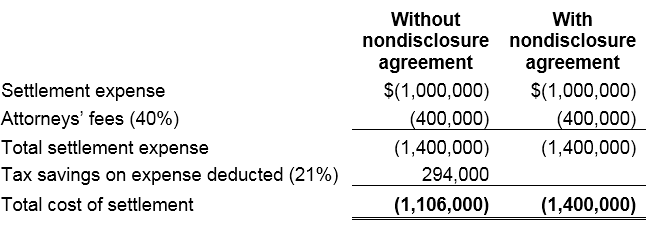
By requiring a nondisclosure agreement, XYZ Co. will pay $294,000 more in tax, which is approximately 27% more. While it is important to note that companies may want to include a nondisclosure for nontax purposes, such as maintaining their reputation, these reasons now come with tax consequences.
How plaintiffs and companies will respond
Because of the considerable tax consequences, this new law will encourage plaintiffs and defendants to refrain from including a nondisclosure agreement in their sexual harassment settlements. Looking at the tax ramifications displayed in the examples above, there is an obvious incentive not to have a nondisclosure agreement. Only time will tell how this will play out, but it is highly likely that an increase in settlements without nondisclosure agreements will cause more victims of sexual harassment to come into the public light when they hear other encouraging voices not silenced by nondisclosure agreements.
Gabrielle N. Roe is an honors student and Mark C. Nielsen, CPA, MBA, is an assistant professor in accounting, both at Morningside College in Sioux City, Iowa. For comments about this article or suggestions of topics for new articles, please contact senior editor, Sally Schreiber, at Sally.Schrieber@aicpa-cima.com.