ASU 2023-09: Public company takeaways and 2026 private company adoption
Editor: Jessica L. Jeane, J.D.
FASB’s issuance of Accounting Standards Update (ASU) No. 2023–09, Improvements to Income Tax Disclosures in December 2023 marked the most significant change to income tax disclosures in decades. The objective is straightforward: to provide financial statement users with clearer insight into the drivers of an entity’s effective tax rate and related tax risks through more structured and disaggregated information, including for the first time adding a disclosure for cash taxes paid in material jurisdictions in which a company operates. The ASU also eliminates certain disclosures deemed less decision–useful by investors and analysts.
Public business entities (PBEs) first applied the standard in their SEC Form 10–K, Annual Report, filings for annual periods beginning after Dec. 15, 2024. Those filings now offer a practical review of implementation considerations. PBEs are defined in ASU 2013–12 and generally include filers of financial statements with the SEC, certain entities with public debt securities, and certain other regulated entities. Private companies, defined as non–PBEs, adopt the standard for annual periods beginning after Dec. 15, 2025.
While non–PBEs have fewer disclosure requirements, experience from PBE adoption highlights where preparation matters most, particularly around data readiness, documentation, communication, and making early policy decisions.
What ASU 2023-09 requires and what’s different for non-PBEs
Tabular rate reconciliation (PBEs only):PBEs must present a tabular rate reconciliation using eight defined categories:
- State and local income tax, net of federal benefit (for the subnational jurisdictions of domicile);
- Foreign tax effects (for tax effects from jurisdictions other than the jurisdiction of domicile);
- Effect of changes in tax laws or rates enacted in the current period*;
- Effect of cross-border tax laws (e.g., net CFC tested income, foreign-derived deduction-eligible income, and base-erosion and anti-abuse tax)*;
- Tax credits*;
- Changes in valuation allowances*;
- Nontaxable or nondeductible items*; and
- Changes in unrecognized tax benefits (generally including all jurisdictions).
(* For the federal (national) jurisdiction of domicile only.)
Generally, items greater than or equal to 5% of expected tax (pretax income from continuing operations, multiplied by the applicable statutory income tax rate; the “5% threshold”) must be separately disclosed by jurisdiction and nature within each category. However, for categories 1, 3, 6, and 8, no such disaggregation is required. If a reconciling item is not appropriate for any of the eight categories listed above, it is reported in the “Other” category and disaggregated by nature if it meets the 5% threshold.
Additionally, PBEs must include a qualitative disclosure describing the state and local jurisdictions that make up greater than 50% of the effect of the first category. The states listed in this disclosure should be listed in descending order of magnitude until the greater–than–50% threshold is achieved.
Disclosure requirements for cash taxes paid (PBEs and non-PBEs)
Both PBEs and non–PBEs must also disclose cash income taxes paid net of refunds, disaggregated among federal, state and local, and foreign jurisdictions. Further details are required to list the amounts paid net of refunds to individual jurisdictions that are material (greater than or equal to 5% of total taxes paid, net of refunds).
Non–PBE requirements: Non–PBEs receive meaningful relief:
- No tabular rate reconciliation required;
- Narrative disclosure remains acceptable but should clearly describe the specific categories of reconciling items and individual jurisdictions that result in a significant difference between the statutory tax rate and the effective tax rate; and
- No jurisdiction-level disaggregation is required in the rate reconciliation.
However, all entities, both PBE and non–PBE, must:
- Disclose pretax income (loss) from continuing operations disaggregated between domestic and foreign jurisdictions; and
- Disclose income tax expense (or benefit) from continuing operations disaggregated by federal, state, and foreign jurisdictions.
These requirements are narrower, but in practice, they still depend on having the right data and processes in place. These non–PBE disclosure adjustments are analyzed in further detail later in this discussion.
All entities may make certain accounting policy elections. When adopted and consistently followed, these elections may provide some flexibility for a company in presenting items in its income tax disclosures for both the tabular rate reconciliation and income taxes paid. For example, current–year tax credits can be presented either gross or net of a related uncertain tax benefit. Income–taxes–paid disclosures could be presented in the tax footnote or with the statement of cash flows. Adopted policy elections should be adequately documented in the accounting records, and consideration should be given to disclosing material policy elections in the tax footnote. It is best practice to evaluate available policy elections early in the implementation to allow time to evaluate which alternative fits best.
Other disclosure changes
ASU 2023–09 eliminates certain disclosures that stakeholders viewed as less useful, including the requirement to estimate reasonably possible changes in unrecognized tax benefits in the next 12 months and certain disclosures related to the cumulative amount of each type of temporary difference related to unrecognized deferred tax liabilities.
Key takeaways from PBE adoption
Adoption method is a strategic choice — prospective vs. retrospective: One of the most significant early decisions for PBEs was whether to adopt the standard prospectively or retrospectively. In the initial year of adoption, the prospective method applies the new disclosure requirements only to the current year, leaving prior periods in the comparative financial statements with the legacy disclosure presentation. Retrospective adoption restates these prior periods into the new disclosure format.
PBE practice reflects a mixed approach to the transition election, although there appears to be a modest preference for prospective adoption. Based on the authors’ experience supporting PBE implementations of ASU 2023–09, slightly more than 50% of PBEs have adopted the standard prospectively. Observations from a sample of large PBEs indicate that both prospective and retrospective methods are commonly used, with the choice generally driven by company–specific facts and circumstances.
Each approach has trade–offs. Prospective adoption is operationally simpler, but it may limit comparability across periods. Retrospective adoption enhances comparability, but it requires reworking historical disclosures to the new format. Additionally, it should be noted that the method of adoption cannot be applied selectively. For example, if the retrospective method was selected, both the rate reconciliation and cash–taxes–paid disclosures would need to be presented on a retrospective basis for all years presented.
Practical takeaway for non–PBEs: Non–PBEs should make this decision early. Even if prospective adoption is selected, companies should consider whether stakeholders will expect or require comparability across periods.
Data readiness could be a challenge
Consistent with initial expectations, the authors noted companies found that the most time–consuming aspect of adoption was not necessarily the technical interpretation of the disclosure, but it was instead assembling the required data. For example, disaggregating income taxes paid required pulling data from multiple sources (tax, accounts payable, etc.) and aligning it by jurisdiction.
PBE experience also reinforces the importance of using historical data to “dry run” disclosures, which helps identify gaps before the year–end process.
Practical takeaway for non–PBEs: Non–PBEs should start with a simple data inventory. They should identify where information on taxes paid and pretax income currently resides, and they should assess whether these items can be readily broken out by jurisdiction. In some cases, small changes to general ledger or payment coding can significantly simplify future disclosures. For example, tax payments are easier to track if they are booked to the income tax payable account as opposed to the income statement. This allows easier tracking of all payments so none are unaccounted for and correctly states the balance sheet and income statement.
Judgment will be needed for disclosure requirements. Even where the standard is prescriptive, companies exercised judgment in how they described and presented information. Early filings show an increased focus on qualitative disclosures, including:
- Clear descriptions of the nature of rate-reconciling items;
- Transparency regarding significant transactions affecting the effective tax rate; and
- Additional context on offsetting items within categories.
This reflects broader stakeholder interest in understanding not just the numbers but the underlying rate drivers.
Practical takeaway for non–PBEs: For non–PBEs, the narrative rate reconciliation would be most helpful to users if it goes beyond high–level descriptions. Focus on clearly explaining the key drivers of the rate and any significant period–over–period changes.
Granularity is manageable but should be evaluated early
For PBEs, the standard increased the level of disaggregation in some cases, particularly when reconciling items were assessed at the jurisdiction level.
While non–PBEs are not subject to this requirement unless they voluntarily present a tabular reconciliation, the lesson is still relevant: Disclosure complexity can increase quickly, depending on the company’s footprint.
Practical takeaway for non–PBEs: Most non–PBEs will find that a clear, well–structured narrative provides the right balance between transparency and efficiency.
Existing ASC 740 documentation can often be leveraged
PBE experience indicates that many of the new disclosures are extensions of existing FASB ASC 740, Income Taxes, analyses, particularly for valuation allowances and effective–tax–rate drivers.
However, the new standard enhances visibility by requiring a more granular disaggregation of valuation allowance activity, including separate disclosure of changes related to federal, state, and foreign jurisdictions, rather than presenting all activity within a single “change in valuation allowance” category. This necessitates more robust tracking of valuation allowance movements at the jurisdictional level and clearer explanations of the underlying drivers, thereby improving transparency into the geographic and structural sources of valuation allowance changes.
Practical takeaway for non-PBEs: Rather than building new analyses, focus on enhancing existing documentation, especially around valuation allowance changes and key rate drivers, to support disclosure-ready explanations.
A structured process makes adoption significantly easier
A consistent theme from both public filings and implementation of guidance is that companies that embedded disclosure considerations into their provision process had smoother adoption. Leading practices include:
- Drafting disclosures early using historical data;
- Leveraging technology and centralized data sources;
- Establishing processes to track uncertain tax positions and jurisdictional data;
- Standardizing foreign data collection; and
- Documenting policy elections to ensure compliance.
Practical takeaway for non–PBEs: Treat disclosure preparation as part of the close process, not a last–step exercise. Small process improvements can significantly reduce effort at year–end.
Putting It all together: A practical approach for non-PBEs
Early PBE adoption reinforces that ASU 2023–09 is less about technical complexity and more about preparation, consistency, and clarity in communication.
A practical approach for non-PBEs includes:
- Deciding early on prospective vs. retrospective adoption;
- Assessing data readiness for taxes paid and pretax income disclosures;
- Drafting disclosures in advance using historical information;
- Refining narrative disclosures to clearly explain key rate drivers; and
- Aligning with auditors early on expectations.
With this approach, ASU 2023–09 becomes an opportunity to present more transparent and decision–useful tax disclosures without significantly increasing an ongoing burden.
Taking a deeper dive into changes for non-PBEs
While the high–level themes from PBE adoption are consistent, several areas warrant closer consideration for non–PBEs, particularly in how required disclosures are prepared and presented.
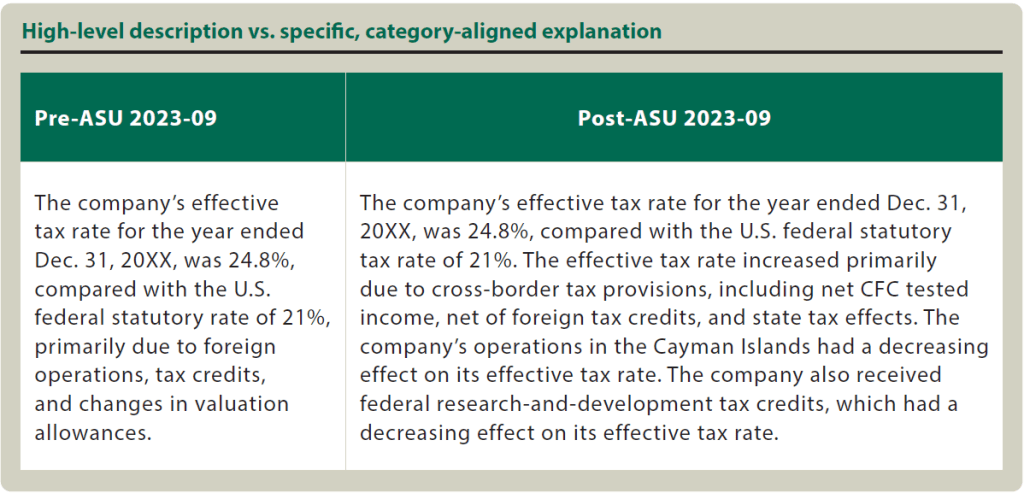
Rate reconciliation discussion: As mentioned above, while non–PBEs are not required to present the tabular rate reconciliation in the new format, the qualitative disclosure provided as discussion of the effective tax rate should follow the categories required by the standard. Providing this information allows users of the financial statements to better understand why the effective tax rate differs from the 21% U.S. federal statutory rate.
Example 1: The table “High–Level Description vs. Specific, Category–Aligned Explanation” illustrates how entities may need to move from high–level descriptions to more specific, category–aligned explanations under ASU 2023–09.
For state taxes, PBEs must qualitatively disclose the domestic state jurisdictions that collectively account for more than 50% of the total state tax effect. Non–PBEs are not required to provide this qualitative jurisdictional disclosure.
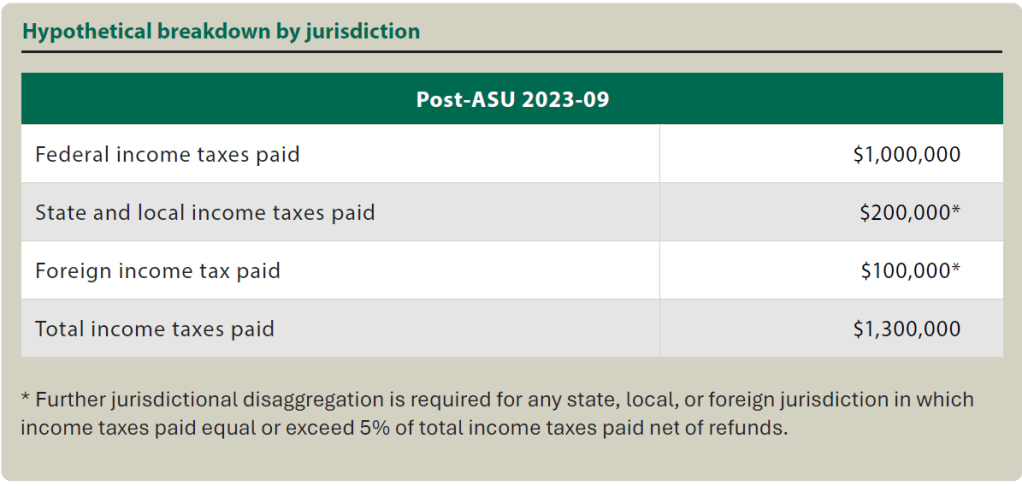
Income taxes paid: Non–PBEs must now disclose income taxes paid by jurisdiction (net of refunds received) equal to or greater than 5% of total income taxes paid, consistent with the requirement for PBEs. Non–PBEs may elect to present these disclosures either in the income tax footnote or within the statement of cash flows.
Example 2: The table “Hypothetical Breakdown by Jurisdiction” shows a hypothetical breakdown of jurisdictions under ASU 2023–09.
Pretax income and income tax expense disclosures: Non–PBEs must disclose (1) pretax income (loss) from continuing operations, disaggregated between domestic and foreign operations, and (2) income tax expense (benefit) from continuing operations, disaggregated among federal, state, and foreign jurisdictions.
Example 3: See a hypothetical comparison of disaggregated pretax income or loss by jurisdiction in the table “Hypothetical Comparison of Disaggregated Pretax Income or Loss by Jurisdiction.”
Note: Entities continue to be required to disclose total current and deferred tax expense (benefit) but may also separately disclose current and deferred tax expense disaggregated by jurisdiction.
Preparing for a smooth transition
ASU 2023–09 represents a shift in focus from the volume of income tax disclosures to their clarity, consistency, and decision usefulness. Early adoption by PBEs demonstrates that the standard’s complexity lies not just in the technical interpretation but also in the processes required to consistently capture, disaggregate, and explain tax information across jurisdictions.
For non–PBEs, the upcoming adoption provides an opportunity to take a more deliberate approach. While the disclosure requirements are more limited than those for PBEs, the underlying expectations around transparency and clarity remain. Companies that begin preparing early by assessing data availability, aligning on key policy decisions, and refining how they communicate effective tax rate drivers will be better positioned for a smooth transition.
Ultimately, successful implementation of ASU 2023–09 is not just about compliance. It is about enhancing the quality of tax disclosures to better reflect the economic realities of an organization’s operations and tax profile. Companies that embed these principles into their provision and reporting processes can turn a disclosure requirement into a meaningful communication tool for financial statement users.
Editor
Jessica L. Jeane, J.D., is director of tax policy, national tax, with Baker Tilly in McLean, Va.
For additional information about these items, contact Jeane at Jessica.Jeane@bakertilly.com.
Contributors are members of or associated with Baker Tilly.
Baker Tilly Advisory Group, LP, and Baker Tilly US, LLP, trading as Baker Tilly, operate under an alternative practice structure and are members of the global network of Baker Tilly International Ltd., the members of which are separate and independent legal entities. Baker Tilly US, LLP, is a licensed CPA firm that provides assurance services to its clients. Baker Tilly Advisory Group, LP, and its subsidiary entities provide tax and consulting services to their clients and are not licensed CPA firms. The name Baker Tilly and its associated logo is used under license from Baker Tilly International limited. The information provided here is of a general nature and is not intended to address the specific circumstances of any individual or entity. In specific circumstances, the services of a professional should be sought. Tax information, if any, contained in this communication was not intended or written to be used by any person for the purpose of avoiding penalties, nor should such information be construed as an opinion upon which any person may rely. The intended recipients of this communication and any attachments are not subject to any limitation on the disclosure of the tax treatment or tax structure of any transaction or matter that is the subject of this communication and any attachments.