Gift or hold? Basis step-up and transfer tax planning after H.R. 1
Editor: Jessica L. Jeane, J.D.
For decades, the primary goal of estate planning for high–net–worth individuals was the reduction of estate, gift, and generation–skipping transfer (GST) taxes by way of lifetime wealth transfer strategies. When the federal estate tax exemption was significantly lower, removing appreciating assets from the taxable estate was often the best tax–minimization strategy. Even after the 2017 Tax Cuts and Jobs Act (TCJA), P.L. 115–97, doubled exemptions and increased the importance of income tax planning, many advisers continued to recommend lifetime gifts to use the exemptions that were scheduled to expire.
H.R. 1, P.L. 119–21, commonly referred to as OBBBA, altered the planning landscape. For 2026, it permanently established a $15 million per person ($30 million per married couple) estate, gift, and GST tax exemption, a historic high that is now indexed for inflation. Before H.R. 1, fewer than 4,000 estates paid estate tax each year. (According to IRS statistics, the number of estates that filed taxable returns totaled 3,690, 3,170, and 2,584 in 2023, 2022, and 2021, respectively.) With a higher exemption that is indexed for inflation, the number of taxpaying estates is expected to drop even further.
In this new planning paradigm, minimizing transfer taxes is no longer the only — or even the primary — tax objective. Income tax planning is now an equally important consideration, particularly because assets acquired from a decedent generally receive a basis adjustment to fair market value (FMV) under Sec. 1014. This adjustment can produce income tax savings that exceed the transfer tax benefits of lifetime gifting.
Today’s estate planners face a difficult question: Is it better to transfer assets during life and remove future appreciation from the estate, or should the client retain those assets until death so that heirs receive a stepped–up income tax basis? This dilemma requires an interdisciplinary approach to estate planning that CPA estate planners, with their analytical and modeling skills, are uniquely qualified to help answer.
This item focuses on the small number of estates that are still taxable following H.R. 1. Obviously, for federally nontaxable estates, preserving the step–up is nearly always the goal. However, state transfer taxes must still be considered, as state exemptions are often smaller.
A difficult multivariable math problem
The answer depends on several variables, including, but not limited to, the size of the estate, the taxpayer’s age, tax rate differentials, growth rates, built–in appreciation, and asset type. The CPA estate planner must consider all these variables and work closely with the client and estate planning attorney to define assumptions and craft an appropriate plan. For example, a young client with decades of potential future asset growth will likely require a different solution than an elderly client with highly appreciated assets he or she expects will pass to heirs in the next few years. In general, the longer the holding period and the higher the expected growth rate, the more likely it is to make sense to gift assets now to minimize taxes.
Tax basis must also be considered. Gifting low–basis assets generally transfers the donor’s basis to the recipient for gain purposes. Accordingly, it is often preferable to gift high–basis assets and hold low–basis assets until death, when Sec. 1014 may adjust the basis to FMV and eliminate the built–in gain.
Current and future tax rates must also be considered. Where an asset is expected to experience significant future growth, the estate tax savings generated by excluding decades of appreciation from the taxable estate can substantially outweigh the future capital gains tax cost associated with the loss of a basis adjustment at death. This result reflects a fundamental tax–rate arbitrage that has long driven estate–freezing strategies. In many cases, taxpayers are exchanging potential exposure to a 40% federal estate tax for future appreciation for capital gains tax exposure that may be taxed at significantly lower rates. The comparison is often even more favorable because estate tax applies to the full value of the transferred appreciation, whereas capital gains tax generally applies only to the gain ultimately realized upon disposition. Additionally, state taxes, additional taxes such as the net investment income tax, and other client–specific variables such as carryforwards could tip the balance in one direction or the other. Complicating matters further, tax rates are subject to change, requiring planners to make assumptions about future tax policy.
Winning assets skew the math
An important exception to the general preference for preserving a basis step–up involves assets with significant appreciation potential (“winning assets”) that are transferred to an intentionally defective grantor trust (IDGT). Although assets transferred to an IDGT generally retain their carryover basis and do not receive a basis adjustment at the grantor’s death, the transfer can still produce a superior overall tax result. The transfer removes the assets’ current value from the grantor’s taxable estate, and all future appreciation accrues outside the estate. Because the grantor remains responsible for the trust’s income tax liabilities, the trust assets can continue to grow without being diminished by income taxes, further enhancing the wealth transferred to the beneficiaries.
As a result, highly appreciating assets often remain excellent candidates for gifting, particularly for individuals whose estates face transfer tax exposure. The key is not to view the loss of basis step–up in isolation but rather to compare the projected estate tax savings from removing future appreciation to the potential capital gains tax cost that beneficiaries may ultimately incur.
The power of this strategy can be illustrated by a real estate enterprise whose owners transferred membership interests to IDGTs for the benefit of their heirs when the company’s enterprise value was approximately $500 million. Twenty years later, the enterprise value has grown to roughly $3 billion. Although the transferred interests will not receive a basis step–up at the owners’ deaths, the $2.5 billion of appreciation has been removed from their taxable estates, producing substantial transfer tax savings. In this case, the estate tax savings attributable to excluding future appreciation from the estate may far exceed the eventual income tax cost associated with the carryover basis, demonstrating the powerful arbitrage between estate tax and capital gains tax rates.
H.R. 1–specific factors
In addition to the estate tax changes noted above, H.R. 1 expanded several beneficial income tax provisions, including the qualified small business stock (QSBS) exclusion and qualified opportunity zones (QOZs). High–net–worth taxpayers and their advisers must be especially cognizant of the interaction of these H.R. 1 provisions with transfer tax planning to maximize their overall tax situation. The following case studies demonstrate the importance of proper modeling and planning.
The QSBS exclusion and the basis adjustment that can waste it: For founders and early investors, few income tax benefits rival the Sec. 1202 QSBS exclusion. It can turn a multimillion–dollar exit into a largely income–tax–free event, and H.R. 1 made it more valuable.
For QSBS acquired after July 4, 2025, H.R. 1 increased the per–taxpayer, per–issuer gain exclusion cap from $10 million to $15 million and introduced tiered exclusions for shorter holding periods — 50% after three years, 75% after four years, and 100% after five years. Beginning in 2027, the $15 million cap is indexed for inflation.
Yet, the time and effort founders invest to qualify their stock for these benefits is lost if the stock is held until death. The step–up in basis at death eliminates the entire built–in gain for income tax purposes, rendering the Sec. 1202 exclusion moot. However, transfer taxes could still apply to the full date–of–death value.
More often, though, liquidity–seeking founders sell their QSBS soon after satisfying the holding–period requirement, and in that case, lifetime gifting can be the more advantageous strategy.
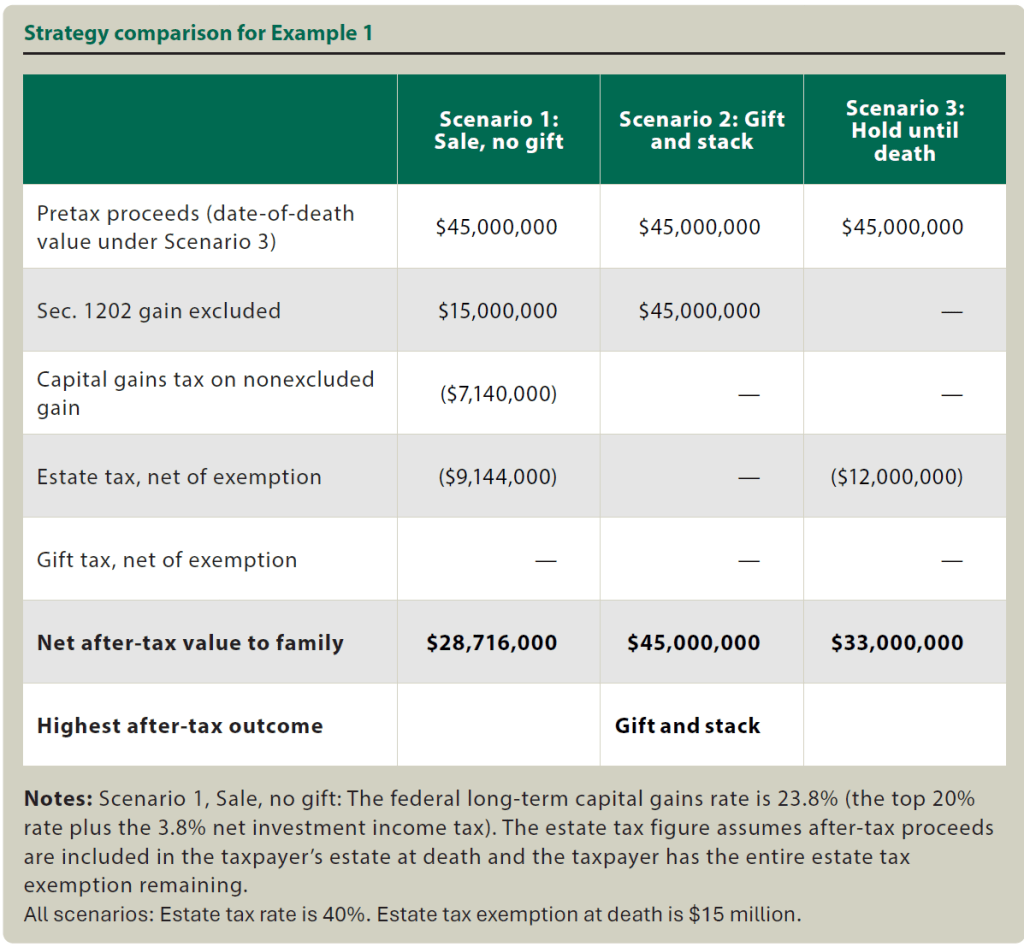
Example 1: B holds zero–basis QSBS acquired in 2026. His per–taxpayer, per–issuer cap is the greater of $15 million or 10 times his aggregate adjusted basis in the stock disposed of during the tax year; because his basis is zero, the 10–times–basis limitation is also zero, so his cap is $15 million. The stock is worth $15 million today. Although a sale is not imminent, the stock is expected to sell for $45 million in the future. B has not yet used any estate and gift tax exemption.
B considers three scenarios: (1) selling all QSBS himself during life; (2) using his full gift tax exemption to give the stock to three separate nongrantor trusts, one each for his three children, which sell the stock; or (3) holding the stock until his death, at which point his heirs sell it.
As the chart “Strategy Comparison for Example 1,” gifting the stock to three nongrantor trusts produces the best after–tax outcome. From an income perspective, the gift and hold decisions are equivalent: Multiplying the QSBS exclusion through lifetime gifting or receiving the basis step–up on death both eliminate the gain. Where the gift option has the advantage is on the transfer tax side: Gifting sends $30 million of future appreciation out of the estate, consuming $15 million of gift tax exemption but incurring no out–of–pocket gift or estate tax. When the income tax results are identical, the optimal strategy seeks to minimize transfer taxes.
A planning point: Some states, including California, do not allow the Sec. 1202 exclusion. Careful planning is necessary to ensure nongrantor trusts are established and administered in conforming or no–income–tax states, so the value of multiple exclusions is not diminished by state tax. Additionally, practitioners must carefully navigate the multiple–trust rule under Sec. 643(f) to avoid the IRS’s aggregating substantially similar trusts, thus negating the separate Sec. 1202 exclusion for each trust.
QOZ investments and basis adjustments without death: Generally, an asset’s basis is stepped up only upon death or in connection with a taxable sale or exchange. Qualified opportunity fund (QOF) investments are different. With QOF investments, eligible taxpayers can obtain a basis increase without dying. Taxpayers who have held a QOF investment for at least 10 years can elect to increase the investment’s basis to its FMV on the date it is sold or exchanged, so any post–acquisition appreciation is generally excluded from income.
That feature makes wealth planning with QOF investments particularly intriguing. By gifting QOF investments to an irrevocable grantor trust, donors can shift an appreciating investment out of their estate while still preserving the basis step–up, an uncommon result among wealth–transfer strategies. In contrast, most strategies require a trade–off between lifetime gifting to save future transfer taxes and holding the property until death to capture the step–up and save income taxes.
H.R. 1 made the QOZ program permanent, so gift planning with QOF investments has continued viability. For QOF investments made on or after the new QOZ program’s effective date of Jan. 1, 2027, the 10–year rule continues to apply, although the new rules cap the step–up period at 30 years (i.e., the basis of investments sold after the 30th anniversary is fixed at the 30–year value).
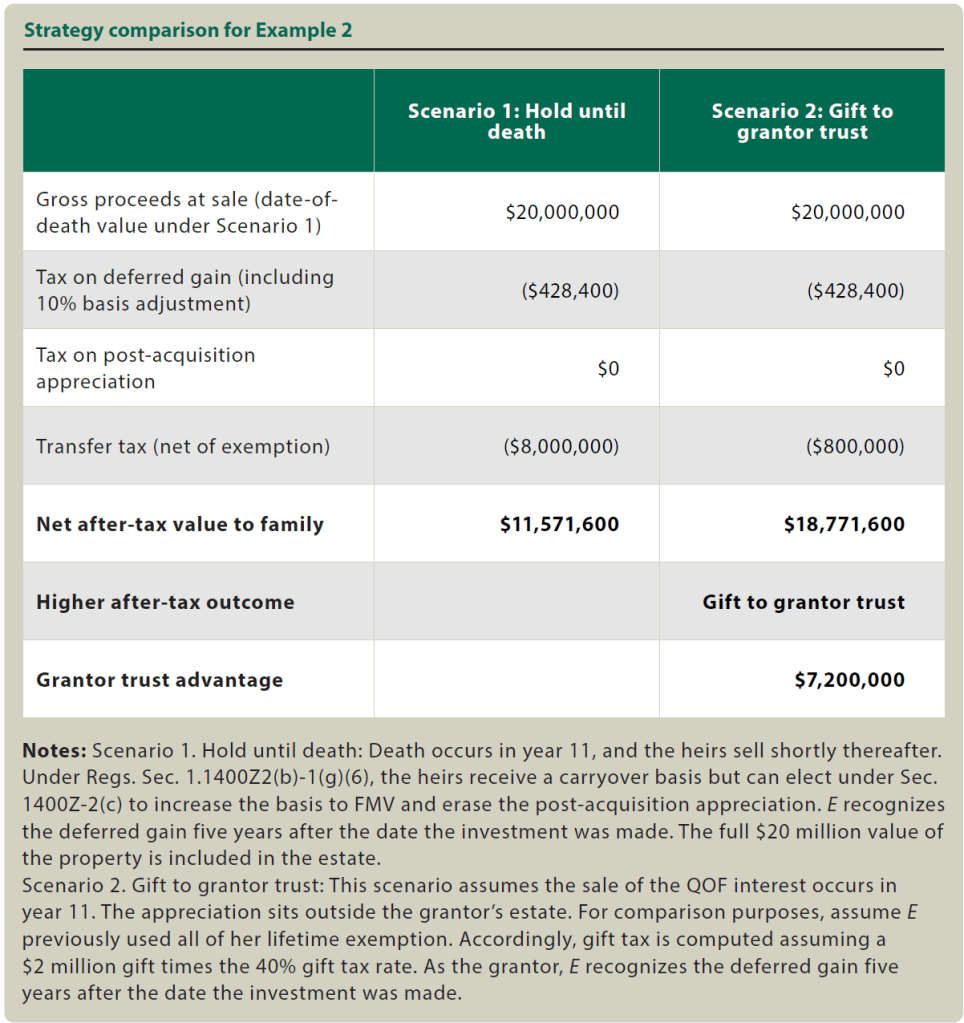
Example 2: E invested a $2 million capital gain in a QOF after Dec. 31, 2026. Soon after making the investment, she gifts it to an IDGT for the benefit of her descendants. Because E used her remaining gift tax exemption on prior gifts, this gift will generate a gift tax liability. She expects the investment to be worth $20 million when it is sold in year 11.
As shown by the chart “Strategy Comparison for Example 2,” even after accounting for the $800,000 gift tax cost, giving the QOF interest to an IDGT produces the higher after–tax outcome. This is due to the rare opportunity that QOF investments offer: the ability to get a basis increase on an asset that is excluded from the gross estate for estate tax purposes.
Caution: For this strategy to succeed, the gift must be to a grantor trust. Under Regs. Sec. 1.1400Z2(b)-1(c)(3), a transfer of a QOF investment by gift generally is an inclusion event that causes any deferred gain to be includable in income and the investment to lose its 10–year rule eligibility. The exception is a transfer to a grantor trust (Regs. Sec. 1.1400Z2(b)-1(c)(5)(i)). Notably, the termination of grantor trust status because of the grantor’s death is not an inclusion event, and the QOF interest remains a qualifying investment after death (Regs. Sec. 1.1400Z2(b)-1(c)(5)(ii)).
A valuable analysis
In practice, reality is much more complicated than the simplified examples above suggest. The CPA estate planner has a valuable role to play in developing models capable of evaluating income and transfer tax considerations simultaneously. Solving this difficult math problem requires careful modeling of several variables, including expected appreciation, transfer tax exposure, tax rates, depreciation recapture, and tax basis. Importantly, the CPA’s analysis must also fit within the constraints of a client’s nontax estate planning goals. Sometimes the most advantageous answer numerically is not necessarily the right one. Following H.R. 1, the CPA estate planner’s role in assisting clients with this difficult question is as important as ever.
Editor
Jessica L. Jeane, J.D., is director of tax policy, national tax, with Baker Tilly in McLean, Va.
For additional information about these items, contact Jeane at Jessica.Jeane@bakertilly.com.
Contributors are members of or associated with Baker Tilly.
Baker Tilly Advisory Group, LP, and Baker Tilly US, LLP, trading as Baker Tilly, operate under an alternative practice structure and are members of the global network of Baker Tilly International Ltd., the members of which are separate and independent legal entities. Baker Tilly US, LLP, is a licensed CPA firm that provides assurance services to its clients. Baker Tilly Advisory Group, LP, and its subsidiary entities provide tax and consulting services to their clients and are not licensed CPA firms. The name Baker Tilly and its associated logo is used under license from Baker Tilly International limited. The information provided here is of a general nature and is not intended to address the specific circumstances of any individual or entity. In specific circumstances, the services of a professional should be sought. Tax information, if any, contained in this communication was not intended or written to be used by any person for the purpose of avoiding penalties, nor should such information be construed as an opinion upon which any person may rely. The intended recipients of this communication and any attachments are not subject to any limitation on the disclosure of the tax treatment or tax structure of any transaction or matter that is the subject of this communication and any attachments.